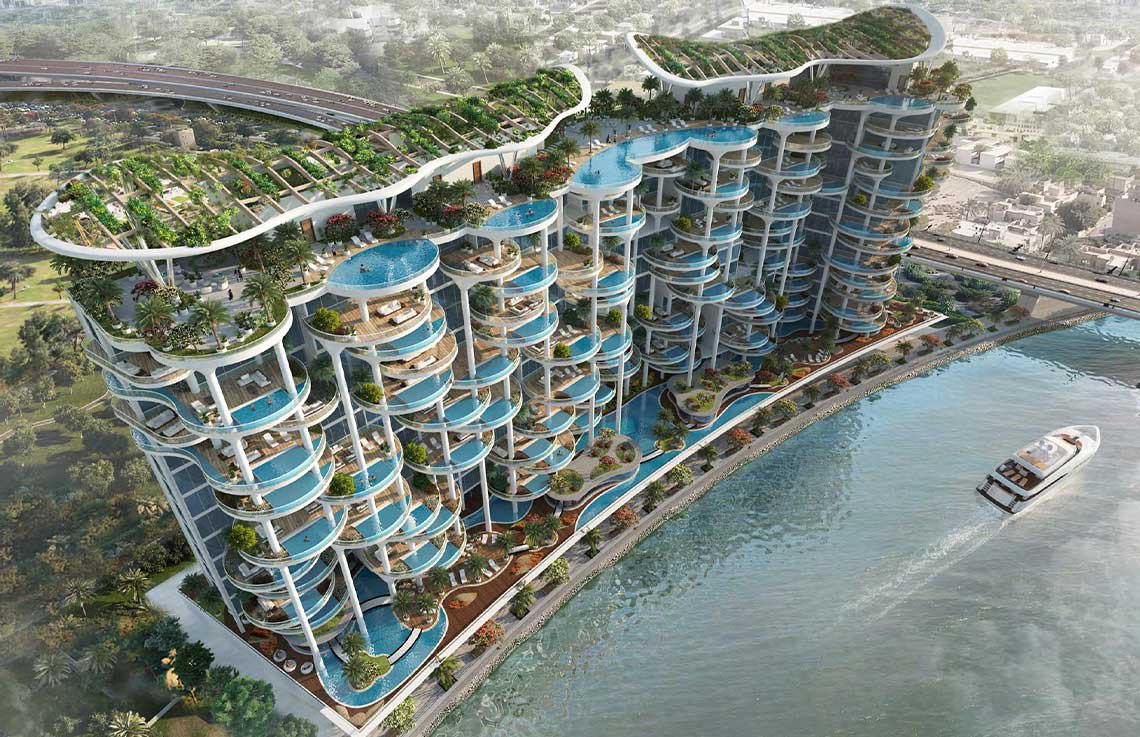
DAMAC sells something most developers cannot: branded luxury at volume. Partnerships with fashion and design houses — Versace, Cavalli, de GRISOGONO among them — plus its own master communities in DAMAC Hills and DAMAC Lagoons, give it a position no competitor occupies in quite the same way. High design, heavy amenity, and payment plans that are consistently among the most accommodating in the market.
That is the pitch. This guide is about what sits underneath it, because a branded residence is one of the easiest products in Dubai to overpay for and one of the harder ones to value. We cover what the brand premium actually is, how DAMAC's flagship communities differ from each other as investments, why the payment plans are structured the way they are and what that structure means for you, and the specific risks in this segment. If you want to see current stock while you read, you can browse off plan Dubai projects filtered by developer and payment plan.
What a branded residence actually is
The term covers a spectrum, and where a given project sits on that spectrum determines whether the premium is defensible.
Licensed interiors versus operated residences
At one end, a branded residence means the developer has licensed a design house's name and aesthetic. The brand supplies the design language, the finishes, sometimes the furniture package. It does not run the building. At the other end sit hotel-operated residences, where an operator manages the property, staffs the service and enforces standards for as long as the agreement runs.
These are very different products with very different economics. A licensed-design residence delivers a distinctive apartment on day one, and from that point the value of the brand depends on how the design ages and how well the building is maintained by whoever runs it. An operated residence carries an ongoing service infrastructure — and an ongoing cost. DAMAC's design-house collaborations sit mainly toward the licensed-design end. Know which one you are being sold before you underwrite the premium, and ask directly: does the brand have any obligation after handover, or does its involvement end at the finish schedule?
What the premium is buying, honestly
A branded unit can command a rental and resale premium because it offers something the wider market does not. That is real. The mechanism is differentiation: in a building of nine hundred functionally identical apartments, a distinctive one stands out to the segment of tenants who care and will pay for design. The size of that segment is finite. It is deeper in central, high-visibility locations and in the short-let market than it is in a suburban long-let.
The failure mode is straightforward. You pay a design premium at purchase, and the rental market values it at less than you paid, so your yield is compressed for the whole hold period. Branding works when it sits on top of solid fundamentals — a location people want, real demand, a credible build — and adds a margin. It does not work as a substitute for fundamentals. A distinctive apartment in a place nobody wants to live is a distinctive apartment in a place nobody wants to live.
The ageing question nobody asks in the sales suite
Strong design is time-stamped. A boldly styled interior that reads as current at launch will read as of-its-era in ten years. That is not automatically bad — some designs age into character — but it is a genuine consideration when the premium you paid assumed the aesthetic was permanent. Consider how replaceable the branded elements are. Fitted joinery and sanitaryware are hard to update; a furniture package is easy. The more the brand is baked into fixed elements, the more you are betting on the design ageing well.
DAMAC's communities are different investments
Treating "DAMAC" as one thing is the main analytical error buyers make. The flagship communities rent to different people and behave differently.
DAMAC Hills
An established master community built around a golf course, with villas, apartments, parks and retail. The word doing the work is established. It has been through delivery, it has real residents, and it has actual resale and rental history you can look at rather than a projection you have to trust. It attracts families and end-users, which means longer tenancies, lower turnover and a second buyer pool at exit alongside investors.
What you give up is the entry-price advantage of buying into something unproven. A mature community has already priced in the amenities that a new one is still promising. That is a fair trade for many buyers — you are paying for certainty and buying out the "will this actually get built as described" risk — but it should be a conscious trade rather than an accident.
DAMAC Lagoons
A Mediterranean-themed community of crystal lagoons, beaches and waterside living, aimed at lifestyle buyers and families wanting resort-style living at accessible prices. It is one of DAMAC's most popular off-plan destinations, and the two honest points about it are the amenity and the timing.
Water features are a real differentiator and a real ongoing cost. Lagoons, beaches and the landscaping around them need continuous maintenance, and that cost lands in the service charge, which comes straight off your net yield every year you own the unit. Ask what the projected service charge per square foot is and treat the answer as a running expense rather than a footnote. Our service charges explainer shows how quickly this moves a return.
The timing point matters more. Buying into a large phased community means your unit may complete while neighbouring phases are still construction sites. If you underwrote your rent assuming a finished resort and hand over into a working site with the lagoon two phases away, your first two years of income will disappoint you. That is not a reason to avoid it — early buyers in a community that delivers do well — but it is a reason to model a slower ramp than the brochure implies.
Business Bay and the central towers
Business Bay is where DAMAC's branded-tower strategy makes the most sense, because it is where the tenant segment that pays for design is actually concentrated. Central location, walkable, on the metro, next to DIFC and Downtown, with corporate long-let demand and genuine short-stay demand sitting on top of each other. That dual demand is the real asset: if one market softens you can pivot to the other. You pay for it in a lower headline yield and, typically, higher service charges than a suburban equivalent. Our Business Bay off-plan guide covers the district's supply picture in detail.
Why DAMAC's payment plans are so generous
DAMAC is known for flexible payment plans, frequently including post-handover components that let rental income help fund the balance after you have the keys. Buyers treat this as a gift. It is better understood as a mechanism, and the mechanism has two sides.
What it does for you
A generous plan lowers the cash you deploy at any single moment, which improves return on capital. You control an appreciating asset while your actual outlay is a series of manageable payments. If a post-handover tranche runs for a few years after completion, rent can cover a meaningful part of it, so the unit partly pays for itself. For an investor optimising cash efficiency rather than total price, this is genuinely valuable and it is why DAMAC's terms are widely admired. The full arithmetic is in our post-handover payment plans guide and the broader payment plans hub.
What it does for the developer
Generous terms are a sales tool. They widen the buyer pool, accelerate absorption, and let a developer clear inventory faster than a competitor demanding more cash upfront. Nothing about that is improper. But it means the terms are part of the price, and you should ask whether the headline price already contains the cost of the financing you are being offered. Where a plan is unusually accommodating, compare the price per square foot to comparable stock nearby on stricter terms. Sometimes the plan is a genuine concession. Sometimes it is priced in. You cannot tell without the comparison, and the sales suite will not run it for you.
The risk in a long plan
A post-handover schedule is a commitment that continues whether or not your rental assumptions hold. If the unit sits empty for four months, the instalment is still due. If rents in your community soften because three neighbouring towers complete in the same quarter, the instalment is still due. Model the plan against a realistic income, not a full-occupancy one, and make sure you can carry it from other resources if the rent underdelivers. Buyers who over-commit across multiple units on generous plans become forced sellers at exactly the moment the market is worst — which is the mechanism by which a good structure turns into a bad outcome.
Short-lets: the strength and the caveat
A distinctive, design-led unit in a central location or an amenity-rich community can perform well in the short-let market. Holiday and corporate visitors increasingly choose serviced apartments over hotels, and a branded finish is a genuine advantage in a listing feed where everything else looks the same. Short-let yields can exceed long-let yields in the right location.
Three caveats, all of which are commonly skipped. Short-letting is a business, not a passive holding — it requires active management or a management company taking a percentage. Occupancy is seasonal, and Dubai's summer is quiet; annual averages are not peak-season rates. And holiday-home operation in Dubai is regulated and requires permits, with rules that apply to the operator and the building. Some buildings and communities restrict it outright, which is a question to ask before you buy, not after. Model it with management fees, a realistic occupancy across twelve months, and the compliance overhead included, using our ROI guide as the framework.
How DAMAC compares to its peers
Each large developer is best at removing a different risk, and that is the useful way to compare them. Emaar offers proven master communities with a full cycle of resale data behind them. Sobha competes on in-house construction control and build quality, which shows up in maintenance costs and resale condition years later — the Sobha guide explains the mechanism. DAMAC's calling cards are branded design, resort-style amenity and notably investor-friendly terms, often at more accessible entry points than the top blue-chip tier.
Pick according to what worries you most. If it is completion and long-run community value, master-community pedigree earns its premium. If it is the state of the building at year seven, build quality does. If it is cash efficiency and standing out in a crowded rental market, DAMAC's combination is hard to match — provided you have checked that the fundamentals underneath the brand are real.
Buying a DAMAC unit: the process and the checks
The mechanics are the standard Dubai off-plan path. You reserve the unit, pay the first instalment plus the 4% DLD fee, sign the sale and purchase agreement, and pay instalments through construction into a project escrow account. The escrow is the structural protection: your money sits in a project-specific account and is released against construction progress certified by an engineer, which is why an off-plan instalment is not simply handed to the developer to spend as it likes. Our escrow explainer covers what that does and does not protect. Foreigners can buy freehold in designated zones without holding residency.
Before you sign, do four things. Read the SPA's completion date and, more importantly, its delay provisions — what happens if handover slips, and what remedy you actually have. Confirm the escrow account and check the project is registered. Get the projected service charge in writing, especially in an amenity-heavy community. And ask what specification is contractually guaranteed versus what is shown in the show apartment, because in a branded product the finish is most of what you are paying for. Then compare the unit against live alternatives across new launches before committing.
Frequently Asked Questions
Is DAMAC a good developer to buy off-plan from? DAMAC is one of Dubai's largest private developers with a long delivery record and a distinctive branded product, and its payment terms are among the most accommodating available. Whether it is right for you depends on your priority. If you want cash efficiency, distinctive design and amenity-rich communities, it fits well. If your dominant concern is proven long-run community value, weigh it against developers with more mature master communities and deeper resale history.
Do branded residences really command higher rents? They can, but the premium depends on tenant demand for design in that specific location, not on the brand name in isolation. Differentiation works best where the paying segment is concentrated — central districts and the short-let market. The risk is paying a design premium at purchase that the rental market values at less, which compresses your yield for the whole hold. Compare achieved rents for comparable branded and unbranded units nearby before assuming a premium.
What is the difference between DAMAC Hills and DAMAC Lagoons for an investor? Hills is an established community with real residents and actual rental and resale history, so you are buying certainty and paying for it. Lagoons is a large phased resort-style community at more accessible prices, where you may capture more upside but can hand over while neighbouring phases are still under construction. Hills suits stability; Lagoons suits a buyer who can carry a slower income ramp.
Can I use a DAMAC apartment as a holiday home rental? Often, but not automatically. Holiday-home operation in Dubai is regulated and requires permits, and individual buildings or community rules can restrict or prohibit it. Confirm the position for your specific building in writing before you buy if short-letting is central to your plan, because discovering the restriction after handover leaves you with a long-let asset you underwrote on nightly rates.
Why are DAMAC's payment plans more flexible than other developers'? Generous terms widen the buyer pool and speed up absorption, so they function as a sales mechanism as much as a concession. That is normal and not a criticism, but it means the financing may be reflected in the headline price. Compare the price per square foot against similar nearby stock sold on stricter terms to see whether you are getting a genuine concession or paying for one.