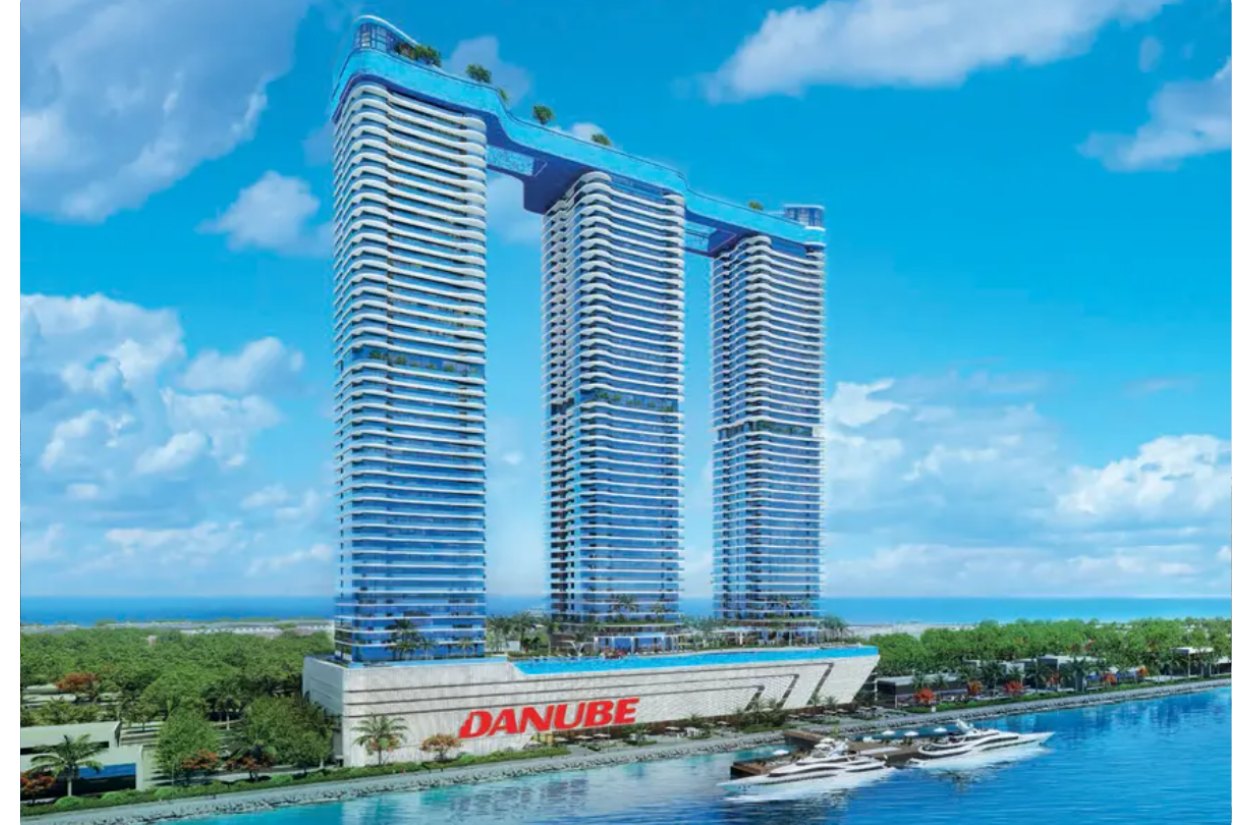
Danube changed how Dubai buys property by changing the unit of measurement. Founded by Rizwan Sajan, Danube Properties pioneered the 1% monthly payment plan: after a modest down payment, you pay roughly 1% of the purchase price every month during construction. That single structure opened off-plan investment to salaried buyers who could never assemble a large lump sum, and it has been copied across the market ever since.
This guide does the thing the marketing does not: it works the arithmetic. What does 1% a month actually add up to over a build? What has to happen at handover, and why does that matter more than the monthly figure? What is Danube genuinely good at, where does it sit against the blue-chip names, and who should walk away? If you want to see current stock alongside the reading, you can browse off plan Dubai projects by developer, community and payment plan.
The 1% plan, mechanically
The structure is simple to state and worth stating precisely, because the simplicity is what makes it powerful and what makes it misread.
- You pay a down payment upfront, typically a modest percentage of the price.
- Through construction, you pay around 1% of the purchase price each month — a small, predictable, calendar-driven instalment.
- The remaining balance is structured so the monthly outlay stays manageable, which is what makes the property feel affordable on a salary rather than requiring a lump sum.
For a buyer, this transforms the maths of entry. Instead of needing hundreds of thousands of dirhams available at once, you secure a property with a modest deposit and a steady monthly commitment you can budget alongside rent, school fees and everything else. It is one of the most accessible structures in the market, and we place it against the alternatives in our payment plans hub.
Do the arithmetic that the brochure does not
Here is the part that matters and that almost nobody spells out. One percent a month over a construction period of, say, thirty months is thirty percent of the price. Add a down payment and you are somewhere in the region of forty percent paid by completion. The purchase price has not changed. So a substantial share of the price — the majority, on many such plans — has to be dealt with at or after handover.
That balance is the real subject of a 1% plan, and it resolves in one of three ways. It is paid as a lump sum at handover. It is spread across a post-handover schedule over a few years. Or it is covered by a mortgage taken out once the property is complete and mortgageable. Each of those is a legitimate route. What is not legitimate is not knowing which one applies to your contract.
Ask the sales agent, in writing, one question: after all my monthly instalments, what percentage of the price is outstanding at handover, and on what schedule is it due? If the answer is vague, that is the answer. This is the single most important question in the whole purchase, and it is the one the 1% headline is structured to make you forget. Our post-handover payment plans guide covers what a deferred balance really costs.
Calendar-linked, not milestone-linked
Most off-plan schedules tie instalments to construction milestones — foundations complete, twentieth floor cast, and so on. Your money follows the concrete. A monthly plan is different by design: it is tied to the calendar. You pay in month fourteen whether or not anything happened on site in month fourteen.
This is a genuine and underdiscussed difference. It is more convenient for you, because your outgoings are predictable and identical every month. It is also better for the developer, because cash arrives regardless of build progress. If a project slips, a milestone-linked buyer stops paying until progress resumes; a monthly-plan buyer keeps paying. Your escrow protection still applies — instalments go into a project escrow account with releases tied to certified progress, which is the structural safeguard explained in our escrow guide — but the rhythm of your payments is decoupled from the rhythm of the build. Know that you are accepting it.
Why the structure is strategically powerful anyway
Having stated the caveats plainly, the plan's advantage is real and worth understanding on its own terms.
Leverage without a bank
A 1% plan lets you control an appreciating asset while deploying minimal cash at any single moment. If the property appreciates during construction, the gain accrues on the full value of the asset while your actual outlay to that point has been a down payment and a series of small monthly payments. That is leverage — the same effect a mortgage produces — obtained from the developer rather than a bank, without an interest rate quoted at you and without a credit application.
It is not free. The cost is embedded in the price rather than itemised as interest, which is exactly why a developer can offer it. That leads directly to the next point.
Compare the price per square foot, not the plan
Deferred payment terms have a cost to the developer, and developers are not charities. Where terms are unusually generous, the price frequently reflects them. This does not make the plan a trick; it makes it a product with a price. The way to see the price is to compare the price per square foot against comparable stock in the same community sold on stricter terms. Sometimes the plan is a genuine concession in a competitive market. Sometimes you are paying for it.
Run that comparison yourself. The sales suite will not run it for you, and the monthly figure is designed to be the only number you look at.
Leverage cuts both ways
Leverage amplifies whatever happens. If values rise during construction, your return on the cash you actually deployed is excellent. If values fall, you are committed to instalments on an asset now worth less than you agreed to pay, and the plan's low entry cost does nothing to help — you still owe the full price. Buyers who over-commit across several units on accessible plans are exactly the buyers who become forced sellers when conditions turn, because the monthly obligations continue regardless of the market. The affordability of the entry is not the same as the affordability of the commitment.
What Danube is actually good at
Accessible positioning and yield-dense communities
Beyond the payment plan, Danube has built its brand on accessibility. Its projects are typically positioned at attainable price points, frequently in the value and mid-market communities where rental yields are strongest — the tenant-dense areas covered in our best areas guide. That is a coherent strategy rather than an accident: the accessible entry point and the high-yield community reinforce each other, because yield is rent divided by price and the price denominator is small.
The honest caveat that comes with those communities is supply. Value areas absorb a large share of the city's new towers, and when several complete in the same quarter, rents can flatten while the units lease up. That is a timing risk, not a permanent one, but it can land on your first year of income — the year you were counting on to start covering things.
Fully-fitted units, and why they matter more than they sound
Danube tends to deliver fully-fitted, ready-to-occupy units, often with furnishing packages, built-in appliances and space-efficient layouts. For a landlord this is more valuable than it first appears. A move-in-ready furnished apartment can be let faster and frequently commands a higher rent than an unfurnished equivalent, particularly among young professionals and in the short-let segment. It also removes the cost, time and coordination of fitting out a unit yourself after handover — which, for an overseas buyer, is a genuinely awkward project to manage remotely.
The counterpoint is that furniture depreciates and fitted packages need replacing. A furnishing package is an asset with a life, not a permanent uplift, and by the second or third tenancy some of it will need renewing at your cost. Budget for it rather than treating the rent premium as permanent and free.
Where Danube sits against the blue-chip names
Emaar sells proven master communities with a full cycle of resale data behind them; the Emaar guide covers how those districts behave. Sobha competes on in-house build quality, which surfaces years later in maintenance costs and resale condition. Danube's distinct edge is affordability and the monthly structure it pioneered. It occupies the accessible, yield-focused end of the market rather than the luxury tier, and it does not pretend otherwise.
That is a clean positioning. If your priority is starting with minimal upfront cash and capturing strong percentage yields, it is hard to beat. If you want a trophy address or the deepest possible resale liquidity in a mature community, look elsewhere — not because Danube is deficient, but because it is built for a different buyer.
Who should buy Danube, and who should not
It suits the first-time investor who wants the lowest barrier to entry and can commit to a predictable monthly figure. It suits the salaried buyer who has income but not a lump sum, which is precisely the buyer the structure was invented for. It suits the yield-focused investor targeting high-rental value communities, and the portfolio builder scaling up with manageable monthly commitments rather than one large deployment.
It suits you less if you cannot answer the handover-balance question and mean it. If the plan only works because you are assuming a mortgage will be available at completion, you are making a financing bet on conditions three years out, and mortgage availability depends on your income, your residency status, the property's valuation on the day, and lending conditions at the time — none of which are guaranteed today. It also suits you less if you are stretching to afford the monthly payment, because the monthly payment is the easy part. The balance is the hard part, and it arrives later.
The buying process and the checks that matter
The mechanics follow the standard Dubai off-plan path: reserve the unit, pay the down payment plus the 4% DLD fee, sign the sale and purchase agreement, and pay instalments into a project escrow account through construction. Your interim ownership is recorded on the Oqood register, which is what makes your interest in a building that does not yet exist a real, recorded thing — the mechanism is set out in our Oqood registration guide. Foreigners can buy freehold in designated zones without holding UAE residency.
Four checks before you sign. Get the outstanding balance at handover in writing. Read the delay provisions in the SPA — what happens if handover slips, and what remedy you actually have. Get the projected service charge per square foot, because it comes off your yield every year whether the unit is let or not. And confirm exactly what the fully-fitted specification includes contractually, as against what is displayed in the show apartment. Then compare the unit against live alternatives across new launches before committing, and check the honest downside in our guide to off-plan risk in Dubai.
Frequently Asked Questions
What is Danube's 1% payment plan? After a modest down payment, you pay approximately 1% of the property price each month during construction, giving you a small and predictable instalment instead of a large lump sum. The balance not covered by those monthly payments is settled at or after handover, either as a lump sum, on a post-handover schedule, or via a mortgage once the property is complete. The monthly figure is the headline; the handover balance is the substance.
Does 1% a month mean I have paid the whole price by handover? No, and this is the most common misunderstanding. One percent a month over a typical construction period plus a down payment covers well under half the price. The remainder is due at or after completion under whatever arrangement your contract specifies. Ask for the outstanding percentage at handover in writing before you sign — it is the single most important number in the deal.
Is Danube a good developer for first-time investors? For the specific problem of entering the market without a large lump sum, it is one of the most practical routes available, and the fully-fitted delivery means the unit can start earning shortly after handover without a fit-out project. It sits at the accessible, yield-focused end of the market rather than the luxury tier, so judge it on that basis. The plan's accessibility is not a substitute for checking the community, the supply pipeline and the handover balance.
Who founded Danube Properties? Danube was founded by Rizwan Sajan, and the company pioneered the 1% monthly payment plan that has since been widely copied across the Dubai market. The structure's significance is that it reframed off-plan buying from a lump-sum decision into a monthly-budget decision, which brought salaried buyers and first-time investors into a market that had largely been closed to them.
What happens if I cannot pay an instalment on a 1% plan? Missed instalments put you in breach of the sale and purchase agreement, and the consequences are governed by that contract and the applicable regulations — which can include penalties and, in serious cases, cancellation with only a portion of what you paid returned. Because monthly plans are calendar-linked rather than milestone-linked, payments fall due whether or not construction is progressing. Read the default and delay clauses before you sign, not after.