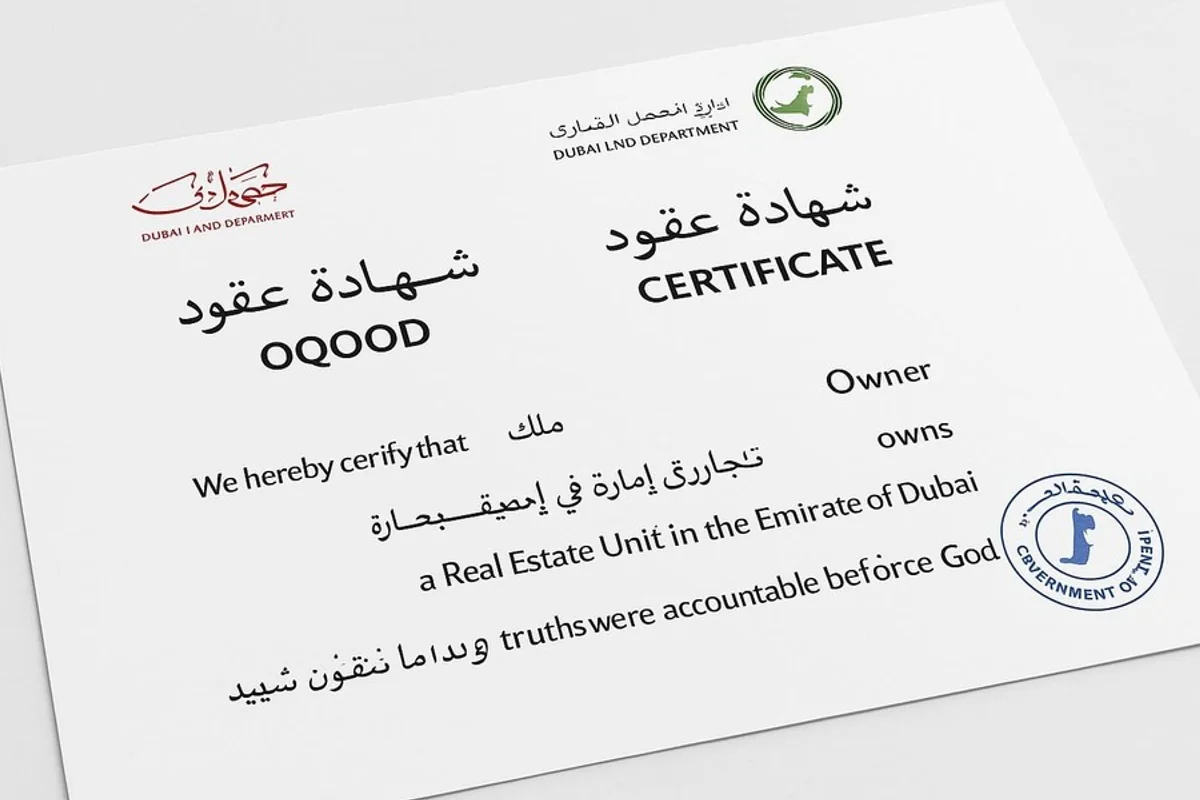
When you buy a completed property in Dubai, you get a title deed. When you buy off plan, there is nothing to hold a title deed over yet, because the unit is a set of coordinates on a drawing. Interim title registration is what fills that gap. It records your interest in a specific unit on an official register before the building exists, and it is the reason an off-plan purchase in Dubai is a recorded property right rather than a private promise from a developer.
In Dubai the practical instrument for this is Oqood, the Dubai Land Department's interim registration system for off-plan sales. This guide covers what the interim register actually records, what it protects you against, what it does not, how it converts to a title deed at handover, and where it goes wrong. If you want to look at live developments alongside this, you can browse off plan Dubai projects and check what stage each one is at.
What interim title registration is
An interim registration is an entry on an official register that says: this unit, in this project, is committed to this buyer, under this contract. It is not a title deed. It does not transfer freehold ownership, because ownership of an unbuilt unit is not a thing that can transfer yet. What it does is convert your contract from a private agreement between two parties into a fact recorded by the state.
That distinction is the whole point. A contract binds the developer to you. A register entry tells everyone else in the world that the unit is spoken for. The second thing is far more powerful than the first, because it operates against people who never signed anything with you.
Interim register versus the main property register
Dubai runs the interim register for units that are sold but not yet completed. When a project is finished and the building is handed over, entries move across to the main property register and become title deeds. The interim register is therefore a waiting room with legal effect: it is temporary in duration but not provisional in force.
Where Oqood fits
Oqood is the DLD's system through which off-plan sales are registered. In normal practice the developer submits the sale for registration, the registration fee is paid, and the buyer receives an Oqood certificate confirming the unit is recorded against their name. Our dedicated Oqood registration guide walks through the certificate itself and what to check on it.
Why interim registration matters
Three concrete protections come out of it, and each one addresses a specific way that off-plan purchases have historically failed.
It makes a double sale visible and therefore difficult
The oldest fraud in off-plan property is selling the same unit twice. Both buyers hold a signed contract. Both believe they own unit 1204. Neither knows about the other until handover, at which point the developer has the cash and the buyers have a lawsuit. An interim register breaks this, because the second sale runs into an existing entry. The unit is already recorded. The registration will not go through clean, and the problem surfaces at the point of registration rather than years later at handover.
It establishes priority
Registered interests rank by their position on the register. If competing claims arise over the same unit, whether from another buyer, a lender, or a creditor of the developer, the register is the reference document for who has the earlier recorded interest. Priority is not a technicality. In a dispute, it is frequently the whole case.
It makes your interest transferable and financeable
A recorded interest is an asset with a known shape. That is what makes it possible to assign your off-plan unit to another buyer before handover, subject to the developer's minimum-payment threshold and an NOC, and it is why a lender can take security over it. An unrecorded contract is much harder to sell and much harder to lend against, because the counterparty cannot verify what they are getting.
How the process runs
The mechanics are straightforward when everyone does their job.
- You sign the sales purchase agreement with the developer and pay the first instalment into the project's escrow account.
- The developer submits the sale for interim registration with the DLD, with the contract and identity documents.
- The registration fee is paid. In practice the DLD fee at this stage is charged as a percentage of the purchase price, and who bears it is a matter of what your contract says, so read the clause rather than assuming.
- The entry is created and you receive an Oqood certificate naming you, the project, the unit and the contract.
- At completion, the interim entry is converted and a title deed is issued in your name once the final payments and handover formalities are done.
The registration fee sits alongside the other transaction costs you should have budgeted for from the start, which our DLD fees and transaction costs guide sets out in full.
What you should hold at the end of it
A copy of the Oqood certificate. Your stamped SPA. Escrow transfer confirmations for every instalment. That set of three documents is your position. Keep them somewhere that is not only the email account of the agent who sold you the unit.
The mistake that costs buyers most: assuming it happened
Here is the failure mode that appears again and again, and it is not exotic. The buyer signs, pays, files the paperwork away and assumes registration occurred because the developer said it would. It sometimes does not. The submission is delayed, the fee sits unpaid, the paperwork has an error, or in the worst case the developer simply has not done it.
The buyer discovers this at the point where they want to do something with the unit: sell it, mortgage it, or take handover. At that moment the discovery is expensive, because you are trying to fix a registration problem under time pressure with a developer whose incentives are no longer aligned with yours.
The fix is trivially cheap and almost nobody does it. Ask for the Oqood certificate. Verify the entry independently through the DLD's own channels rather than accepting a PDF as proof. Do it within weeks of paying, not years later. An interim registration you have not confirmed exists is functionally the same as no interim registration at all, right up until the moment it matters.
What interim registration does not do
Being precise about the limits is more useful than reassurance about the protections.
- It is not a guarantee of delivery. The register records your claim to a unit. It does not make the unit get built. If the project stalls, you hold a recorded interest in an unfinished building.
- It is not a valuation. Nothing in the register says the unit is worth what you paid.
- It is not the same as escrow. Registration protects the ownership claim; escrow protects the money. They are separate systems solving separate problems, and you want both. See our guide to escrow accounts and deposit protection.
- It is not a title deed. Until conversion at handover, you hold a recorded interest in an unbuilt unit, which is a real right but not full registered ownership.
- It does not fix a bad contract. The register records the deal you signed. If the SPA has a weak completion date or a one-sided cancellation clause, registering it records those terms faithfully.
Practical points for buyers, sellers and lenders
If you are buying
Check the project is registered and the developer licensed before any money moves. Confirm your own registration afterwards. Read the contract clause that says who pays the registration fee, because assuming and being wrong is an avoidable cost. Keep originals.
If you are buying from an existing off-plan buyer
This is an assignment, and it is where diligence matters most. Verify the seller is actually the registered party on the interim entry, not merely someone holding a contract. Confirm the developer will issue an NOC and what it costs. Establish how much of the price has been paid, because the developer's minimum-payment threshold determines whether the assignment can proceed at all. A seller who cannot evidence their registration is a seller you should walk away from.
If you are lending
Security over an off-plan unit depends on the interim entry being clean and correctly recorded. Confirm the entry and its priority position at the register itself rather than relying on documents provided by the borrower or the developer.
When you are comparing developments and want to see which ones are at which registration and construction stage, the full project listings are the place to start.
Frequently Asked Questions
Is interim title registration the same as Oqood? In Dubai, effectively yes. Oqood is the Dubai Land Department's system for registering off-plan sales on the interim register, so an Oqood certificate is the evidence that your interim registration exists. "Interim title registration" is the generic description of what Oqood does.
Do I get a title deed when I buy off plan? Not at purchase. You get an interim registration, which records your interest in the unit. The title deed is issued after the project completes, final payments are made and the unit is handed over, at which point the interim entry converts.
What happens if the developer does not register my purchase? Your contract still binds the developer, but your interest is not recorded, so it is not visible or enforceable against third parties in the same way. This is why you should ask for the certificate and verify the entry yourself rather than assuming it happened.
Can I sell an off-plan property before handover? Yes, subject to the developer's minimum-payment threshold and an NOC. Most developers require a set share of the price to be paid before they will approve an assignment, and the interim entry is then transferred to the new buyer. Check the threshold in your contract before you plan an exit around it.
Who pays the registration fee? It depends on the contract. The DLD registration fee at the off-plan stage is charged as a percentage of the price, and some developers absorb it as a sales incentive while others pass it to the buyer. Read the clause rather than relying on what you were told verbally.
Does interim registration protect me if the project is cancelled? It establishes that you are a recognised buyer of a specific unit, which matters in any regulated cancellation process, but it does not by itself return your money. That comes through the escrow framework and the DLD's process for cancelled projects.