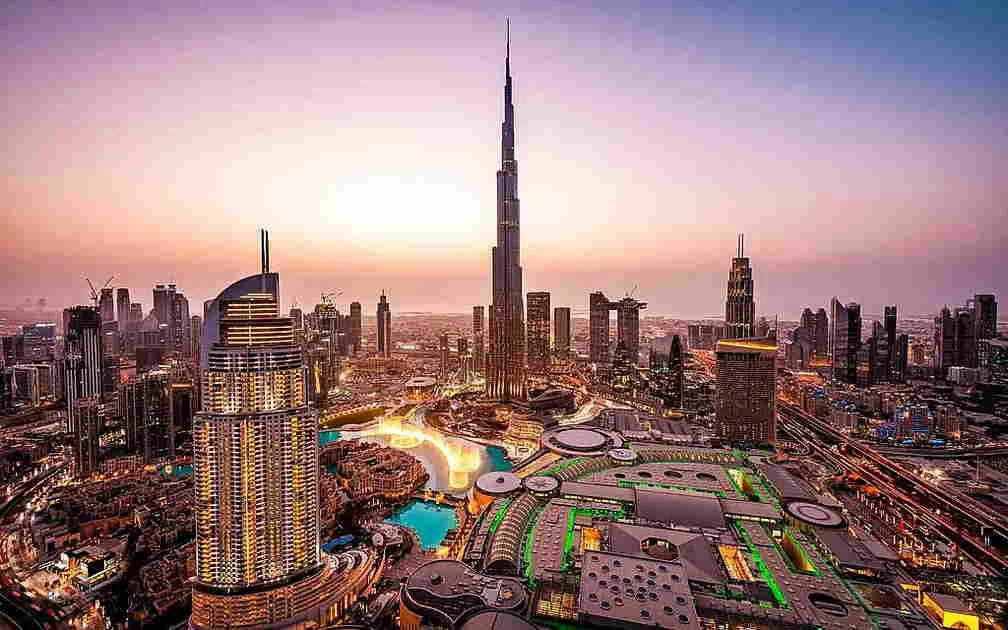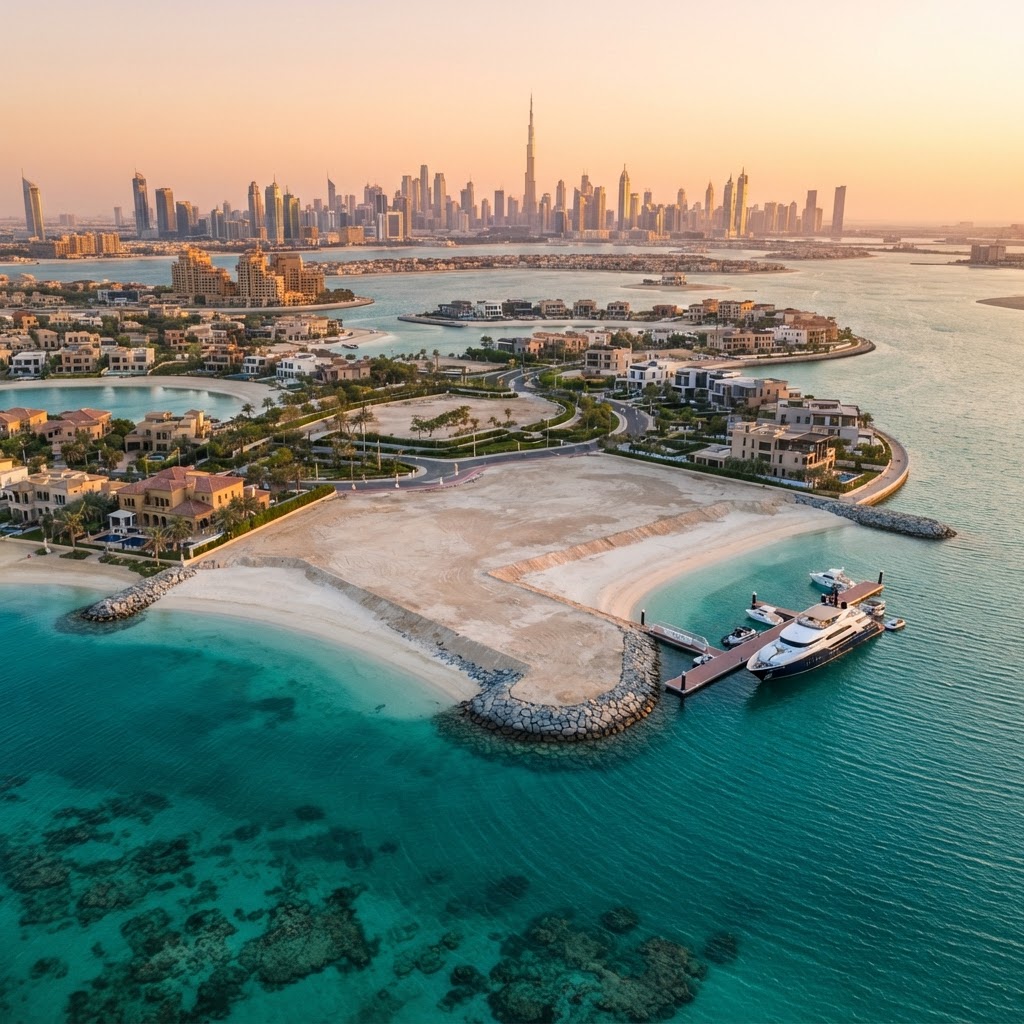
Dubai's ultra-prime land market has a new focal point. A single beachfront plot on Naia Island recently changed hands for a reported Dh377 million — a new benchmark for raw waterfront land in the emirate, and a clear signal that appetite for scarce, large-scale coastal plots remains intense even as the wider market cools from its 2025 peak. It followed an earlier record set in May 2026 for another sizeable beachfront parcel: back-to-back milestones that point to a trend rather than a one-off.
Almost nobody reading this will bid on a Dh377 million plot. The reason the number is worth your time is that it is one of the few honest scarcity signals in a market full of manufactured ones — and it is also a case study in how to read a headline transaction without being fooled by it. This article covers what the deal actually indicates, what it does not, and how the logic at the very top does and does not transmit down to a unit you might realistically buy. Live stock is a click away if you want it: browse off plan Dubai projects across the city.
Why land, and why now
Most headlines track finished homes. The real scarcity in Dubai sits one step earlier.
Developable beachfront is the constrained input
Prime coastal plots large enough to build a signature mansion or a boutique branded project are extremely limited. Apartments can be added vertically; land cannot be added at all except by building it, and building it takes years and enormous capital. That asymmetry is the entire story. When a buyer pays a record for a parcel, they are not paying for a house — they are paying for the right to be one of a small number of parties who can ever build in that spot.
Land buyers are pricing a different thing than home buyers
Someone buying a finished villa is pricing an existing asset with a known specification. Someone buying a plot is pricing optionality: the ability to build exactly what they want, to a specification nobody else can match, on a frontage nobody else can replicate. Optionality is worth more to the wealthiest buyers than to anyone else, because they are the only ones who can fund it. That is why the very top of the market expresses itself in land rather than in houses.
Why a second record matters more than the first
One record is an event. Two in the same year, on the same kind of asset, is a pattern — and a pattern is what separates a data point from a trend. The recent benchmark plot followed an earlier record set in May 2026 for another sizeable beachfront parcel. That sequence is the part of this story that carries actual information.
Read the ultra-prime segment with care
This is the section most coverage skips, and it matters more than the number itself.
The segment is thin and opaque by nature
A handful of transactions a year, each negotiated privately, each with unique characteristics. There is no meaningful "market price per square foot" for a trophy plot, because there are no comparables in the sense the term normally means. Every deal is its own market. That makes averages meaningless here in a way that is not true of a JVC one-bed.
Some reported numbers have drawn scrutiny
Separately reported transactions at even higher values have drawn public scrutiny over exactly how they appear in Dubai Land Department records. That is worth stating plainly, because it demonstrates how thinly traded and how difficult to verify this segment can be. A reported price is a claim until it is a registered transaction, and in a segment where structures can be complex, the distance between those two things is sometimes large. Healthy scepticism here is not cynicism. It is the same discipline you would apply to any number that arrives without a receipt.
What survives the scepticism
The verified takeaway is the direction of travel: confirmed record-setting plot sales, limited supply, and buyers prepared to pay a premium for irreplaceable waterfront. That is a durable observation even if any individual figure is later revised. The direction is the signal; the decimal places are not.
What it signals for the rest of the market
Ultra-prime demand is a confidence indicator. It is a weak one for pricing and a reasonable one for sentiment, and the difference is worth being precise about.
Scarcity at the top supports the floor, not the ceiling
When the world's wealthiest are securing trophy plots, it tends to reinforce the floor under Dubai's luxury and off-plan segments — the same dynamic that has kept prime communities and branded residences resilient through 2026. What it does not do is tell you that a mid-market apartment will appreciate. The buyer of a Dh377 million plot and the buyer of an AED 900,000 one-bed share a city and almost nothing else: different motivations, different funding, different sensitivity to rates, different reasons to sell.
The transmission mechanism is capital, not price
Land records do not push apartment prices up directly. What they indicate is that serious international capital still regards Dubai as a place to hold long-term wealth, and capital of that kind tends to arrive with a broader footprint: family offices, businesses, the demand for staff, schools and services that follows. That footprint is real and slow. It is not a reason to pay more for a unit this quarter.
What it says about waterfront specifically
The clearest read-through is to coastal product generally. Established waterfront addresses like Palm Jumeirah hold value on the same logic that is repricing raw land: the frontage cannot be reproduced. If you want to understand how that scarcity behaves in a market you can actually transact in, our Palm Jumeirah off-plan guide covers what waterfront supply and pricing look like at unit level, and Nakheel is the master developer behind much of the emirate's engineered coastline.
How to use a headline transaction
Trophy deals are useful to a normal buyer in three specific ways and misleading in most others.
- As a sentiment check, not a price input. They tell you the top of the market is confident. They do not tell you what to pay for anything.
- As a lesson in what scarcity actually is. Irreplaceable frontage is scarce. A "limited release" of 200 apartments is a sales tactic. Once you have seen what real scarcity costs, the manufactured kind is easier to spot.
- As a reminder to verify. The scrutiny over how some reported deals appear in official records is a general lesson: what is registered is a fact, what is announced is a claim. That distinction applies to your purchase too.
- Not as a comparable. Ever. There is no ratio that connects a trophy plot to a residential unit.
What this means if you are buying further down the chain
The honest answer is: very little, directly, and something, indirectly.
Your unit is still priced by its own submarket
The price you should pay is set by transacted comparables in your community, the supply handing over alongside you, and the payment schedule you sign. None of those variables move because of a land record. If a salesperson uses Naia Island as a reason for you to pay more for an apartment several districts away, that is a sales argument, not an analysis.
The structural attractions are the same ones at every level
What draws capital to the top of this market also draws it to the middle: no annual property tax on residential ownership, freehold ownership for foreign nationals, and a residency route attached to property above the qualifying threshold. Those apply to a AED 2 million apartment and to a Dh377 million plot alike. Our guides to tax-free property investment in Dubai and the Golden Visa through property set out how each works in practice.
Confidence is not a substitute for underwriting
A resilient floor under the luxury segment does not make a weak developer strong, a bad location good, or an over-priced launch cheap. Ultra-prime confidence is a backdrop. Your return comes from the entry price, the delivery, and the supply you sell into. Keep those separate from the mood music.
Naia Island's land records underline a simple truth about Dubai's top end: waterfront land is finite, demand is not, and the buyers chasing it are among the most confident in the world. That is genuinely useful information about the direction of the market and about how scarcity is priced when it is real. It is not a price signal for your purchase, and treating it as one is exactly how a good market talks people into bad transactions. If you want to see what waterfront and prime product looks like at a price you can transact at, our new launches page tracks what has just come to market.
Frequently Asked Questions
How much did the Naia Island plot sell for? A single beachfront plot on Naia Island recently changed hands for a reported Dh377 million — a new benchmark for raw waterfront land in the emirate. It followed an earlier record set in May 2026 for another sizeable beachfront parcel, making the pair a pattern rather than a one-off.
Why is beachfront land more expensive than finished homes? Because it is the constrained input. Apartments can be added vertically, but coastal frontage cannot be reproduced except by building new land, which takes years and enormous capital. A plot buyer is also paying for optionality — the right to build exactly what they want on a frontage nobody else can replicate.
Do record land sales mean Dubai property prices will rise? Not directly. Ultra-prime demand tends to reinforce the floor under the luxury and off-plan segments, but it is a sentiment indicator rather than a price input. A mid-market apartment is priced by transacted comparables in its own community and by the supply handing over alongside it, not by what a trophy plot achieved.
Can you trust the reported prices in Dubai's ultra-prime segment? Read them carefully. Separately reported transactions at even higher values have drawn public scrutiny over exactly how they appear in Dubai Land Department records, which shows how thin and opaque this niche is. Treat a reported price as a claim until it is a registered transaction — the direction of travel is more reliable than any single figure.
Should a normal buyer pay attention to trophy deals at all? Yes, for two things: as a check on top-end confidence, and as a lesson in what real scarcity looks like. Irreplaceable frontage is scarce; a "limited release" of 200 apartments is a sales tactic. Never use a trophy plot as a comparable — there is no ratio that connects the two.