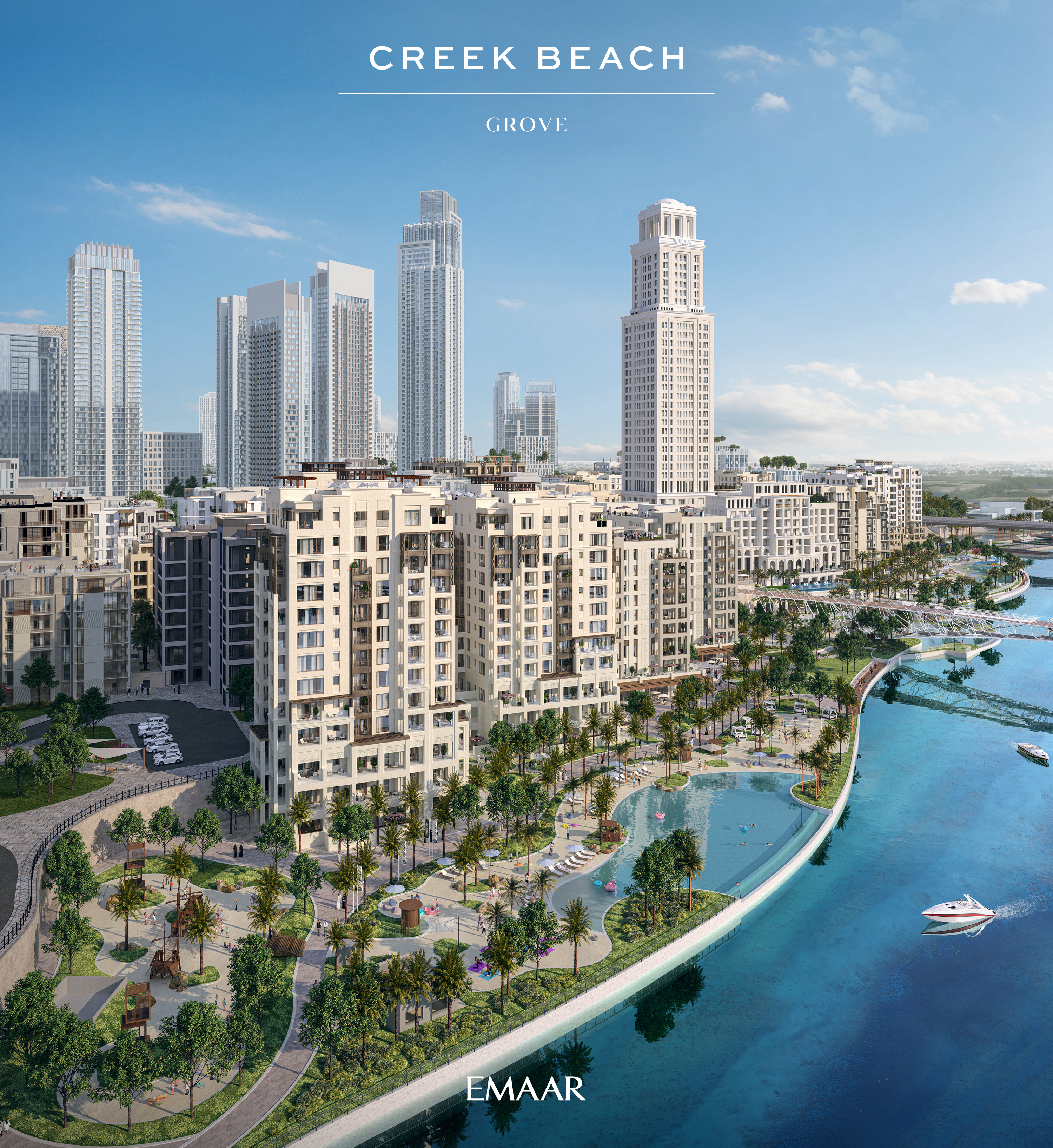
The Oasis is Emaar's luxury villa masterplan, and it sits at the top end of what the developer builds: spacious freehold villas and mansions arranged around man-made lagoons and flowing waterways, on a low-density plan designed to keep unit counts down and privacy up. Emaar describes it as a seamlessly refined indoor-outdoor living experience. Stripped of the brochure language, it is a large-format villa product aimed at high-net-worth buyers who want land, water frontage and an Emaar delivery record behind them.
That combination is genuinely scarce, and scarcity is the whole thesis. It is also the reason this is one of the harder off plan Dubai decisions to get right: the tickets are large, the buyer pool is narrow, and the difference between a good plot and an average one inside the same community can be worth more than the difference between two communities. This guide walks the product, the money and the risk without pretending the numbers are published when they are not.
The concept and the master plan
The Oasis spans hundreds of acres of landscaped terrain, designed by international architects and master planners. At the heart of the development are man-made lagoons and waterways that meander through the neighbourhoods, creating waterfront plots for many of the villas. The plan is built so each cluster enjoys views of greenery and water, with parks and walking trails threaded between them, and careful grading so individual homes maximise their outlook.
What low-density actually buys you
Low-density planning limits the number of units, and that limit is doing real financial work. In a high-density community, your exit competes with every identical unit in the tower, and the person who needs to sell fastest sets the price for everyone. In a low-density villa enclave with meaningful plot variation, there are fewer directly comparable homes, so a forced seller of a mid-plot villa does not automatically reprice a lagoon-front one. Fewer comparables cuts both ways: it protects the good plot and makes every plot slower to sell, because the buyer pool that can write the cheque is small.
Architecture and the water
The architectural style blends modern design with traditional Middle Eastern motifs: clean lines, large windows and natural materials chosen to sit with the landscape. The lagoons are not only scenery. Water frontage is the single clearest price differentiator inside a community like this, it moderates the microclimate, and it supports uses like kayaking and paddle boarding that a pool cannot. When you compare two units at The Oasis, the water relationship, direct frontage, filtered view, or none, will explain more of the price gap than the internal specification does.
Villa types and what you are actually choosing between
The Oasis focuses on freehold villas and mansions built for multigenerational families and buyers who want privacy at scale. Property options are expected to range from four-bedroom villas around 6,000 square feet up to seven-bedroom mansions exceeding 20,000 square feet with customisable layouts. Many villas offer basements, private pools, landscaped gardens and roof terraces; the larger mansions may include home cinemas, gyms and staff quarters.
Buyers are typically offered several design collections, each with a distinct architectural theme and interior palette, ranging from contemporary minimalism through classical elegance to an Arabian-inspired aesthetic. As with any off-plan purchase, some upgrades or layout changes can be requested at the time of buying, subject to developer approval.
The trade-off nobody frames for you
Bigger is not automatically better here. A 6,000 square foot four-bedroom has a wider resale audience than a 20,000 square foot mansion, and a wider audience means faster liquidity and a tighter bid-ask spread on exit. The mansion may appreciate more in percentage terms during a strong cycle because trophy stock is supply-constrained, but it can sit for a long time in a soft one. Match the format to how long you can hold, not to the render.
Customisation has a cost you pay at resale
Heavily personalised layouts and finishes feel like value at signing and read as someone else's taste at resale. Structural changes are worth requesting where they broaden the home's use, such as a flexible ground-floor room. Deeply specific choices are worth requesting only if you intend to live there.
Amenities and the lifestyle case
The community is planned around a waterfront promenade with restaurants, cafes and boutique retail, several clubhouses providing dining, lounges, event spaces and concierge services, and sports facilities including fitness centres, tennis courts, cycling paths and jogging tracks. Family-oriented provision includes kids' play areas, nurseries and shaded parks; wellness comes through spas, yoga pavilions and meditation gardens. Like other Emaar communities, expect smart-home integration, community security and on-site maintenance.
The honest note: in an off-plan villa masterplan, amenities arrive on their own schedule, generally after the first homes hand over. Early residents live with completed houses and unfinished promenades. That is normal, it is temporary, and it is worth asking about explicitly, because a clubhouse two years behind your handover changes what your first two years feel like and what a tenant will pay.
Payment plans and pricing
Emaar is known for flexible payment structures on off-plan releases, and The Oasis is expected to follow the pattern. A typical plan of this type might involve a 10 percent booking fee, followed by 60 percent of the price spread across construction milestones over three to four years, with the remaining 30 percent due on completion. Post-handover schemes may be available on selected units, easing the burden at handover.
Why the structure matters more than the headline split
The number that decides your cash-flow risk is not the split, it is the timing. A 60 percent construction tranche paid against milestones means your capital goes out as the building goes up, and if the schedule slips, your payments slip with it, which is a cash-flow benefit, not a loss. The 30 percent at completion is the sharp edge: it lands as one payment on handover, at whatever your circumstances are in three or four years. Post-handover plans exist to soften exactly that, and their real function is to convert a lump sum into instalments you can service from rent or income. Our post-handover payment plans guide explains the mechanics, and the payment plans hub compares structures side by side.
On the price question
Pricing at this tier is released release-by-release rather than published as a fixed list, and figures circulating for a given phase are frequently stale or third-hand. Some analysts have suggested entry pricing for the smaller villas runs into the eight figures, rising sharply for waterfront plots and larger mansions, but treat that as commentary and not as a quote. Get the price from the release for the specific plot you are looking at, and price the plot, not the community.
Location and connectivity
Emaar has not made an exhaustive public disclosure of the site's exact boundaries, and reporting places The Oasis in an emerging corridor with access to major arterial routes including Sheikh Mohammed Bin Zayed Road, which is what connects it to Downtown, the Marina and the airports. Master planning of this type generally includes dedicated entrances and internal roads to manage traffic without compromising security, with schools, healthcare and retail within a drive rather than a walk. The green belts and water bodies also moderate the local microclimate.
Be realistic about what an emerging corridor means at handover. Drive times published at launch describe the road network as planned, not as it exists on the day you move in. If schooling matters, verify the specific schools and the actual commute, not the masterplan's promise of proximity.
The investment case, and where it breaks
The supportive facts are real. High-end villa supply in Dubai is structurally limited, because land for low-density product near the city is finite in a way that tower plots are not. Emaar's delivery record removes much of the execution risk that dominates off-plan. And the tax position is unusually favourable: no annual property tax, no tax on rental income, no capital gains tax, with a one-off 4% DLD fee at purchase, as set out in our tax-free property investment guide.
Now the other side. Trophy villas are a capital-growth and lifestyle asset, not a yield asset: gross yields at this price point sit well below what a mid-market apartment produces, because rents do not scale with price at the top of the market. Liquidity is thin by design, and thin liquidity is a feature in a strong cycle and a problem in a weak one. Service charges on a large villa with extensive community landscaping and water infrastructure are a material annual number, and they are covered in our service charges guide. And the exit before handover is not free: assignment requires developer approval and a minimum share of the price paid.
If you want to see how this format compares with the rest of the market before committing, review current Emaar releases, compare against Dubai Hills Estate, where the villa product is more established and the comparables are real, and run the arithmetic properly using our ROI calculation guide.
Frequently Asked Questions
What is The Oasis by Emaar? It is Emaar's luxury off-plan villa masterplan, spanning hundreds of acres arranged around man-made lagoons and waterways. It is low-density by design, focused on freehold villas and mansions with resort-style amenities, clubhouses and a waterfront promenade, aimed at buyers seeking large-format homes and privacy rather than rental yield.
What sizes are the villas at The Oasis? Property options are expected to range from four-bedroom villas of around 6,000 square feet to seven-bedroom mansions exceeding 20,000 square feet with customisable layouts. Larger homes may include basements, private pools, roof terraces, home cinemas, gyms and staff quarters, and buyers can typically choose between several design collections.
What payment plan does The Oasis offer? Emaar has not published a single fixed plan for every release. A typical structure of this type is a 10 percent booking fee, 60 percent across construction milestones over three to four years, and 30 percent on completion, with post-handover options on selected units. Confirm the schedule in the SPA for your specific unit, because it varies by phase.
Can foreigners buy a villa at The Oasis? Yes. The homes are freehold and available to buyers of any nationality, with no requirement to be resident in the UAE to purchase. Ownership during construction is recorded through interim registration until the title deed is issued at handover.
Is The Oasis a good rental investment? It is better understood as a capital-growth and lifestyle asset. Gross yields at the top of the villa market are structurally lower than in mid-market apartments, because rents do not rise proportionally with purchase price. If income is your objective, a smaller apartment asset will usually out-yield a mansion by a wide margin.
Can I sell an Oasis villa before handover? Generally yes, subject to Emaar's minimum-payment threshold and approval of the assignment, and any transfer fee that applies. At this price tier, assume the resale audience is small: a plot that suits few buyers can take a long time to move even in a strong market, so do not build a plan that depends on a quick exit.