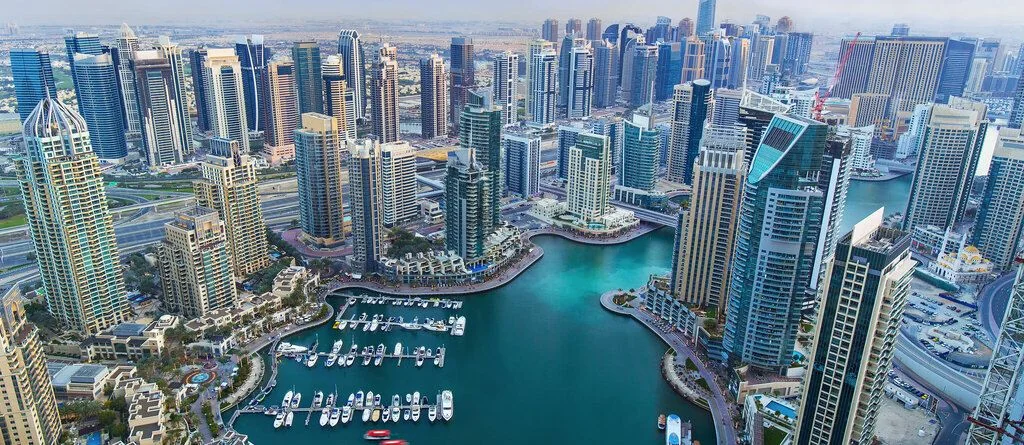
Apartments are the entry point to Dubai's off-plan market. They are more accessible than villas, they make up the largest share of new-build supply, and they are the unit type with the deepest pool of both tenants and future buyers. That combination is why most people reading about off plan property in Dubai are, whether they have decided it yet or not, reading about an apartment.
This guide covers what a 2026 buyer needs to know: where to buy, what you will pay, how the payment plans actually work, and how to avoid the mistakes that are common precisely because they are easy to make. It is written on the assumption that you are committing real money and would rather read the awkward parts here than discover them at handover. You can browse off plan Dubai projects by community and budget alongside the reading.
Why off-plan apartments, and what the product actually is
Off-plan apartments let you control an appreciating asset for a fraction of its value upfront, paying in instalments during construction. That sentence contains the entire case and the entire risk, so it is worth unpacking rather than repeating.
The staged payment is the product
You are not buying an apartment. You are buying a contractual right to an apartment that will exist, and paying for it on a schedule tied to the building going up. Launch pricing typically sits below comparable ready stock, and that gap is your compensation for taking on construction risk, for waiting, and for the possibility that the finished product is worse than the render. When the gap disappears — when a launch prices at or above finished units nearby — you are being asked to take that risk for free.
The staging also means a given amount of capital controls a larger asset than it could in the ready market. That is leverage. It works both ways, and buyers who commit to more units than their income can carry through to handover discover the second way at the worst possible time.
The yield is real and the yield is gross
Dubai apartments deliver some of the strongest gross rental yields of any global city, often 6–8%, tax-free. Both of those qualifiers matter. Gross means before service charges, before management, before the weeks the unit sits empty between tenants. Tax-free means the comparison against a city that taxes your rental income is not a like-for-like comparison of headline percentages; the Dubai number survives contact with a tax return in a way the other number does not. Work the deductions through before you accept any headline percentage as your return.
Where the yield comes from is arithmetic, not opinion
Rents do not scale linearly with unit size. A one-bedroom does not rent for half what a two-bedroom rents for, because a large part of what a tenant pays for is an address, a front door and a set of building amenities rather than square footage. So the smaller the unit, the higher the rent per square foot and the higher the percentage yield. This holds across almost every community in the city. The mistake is treating that percentage as the whole answer: a high yield on a small base produces less absolute cash, and two small units do not manage themselves as easily as one larger one. Our guide to 1-bed off-plan apartments goes deeper into that trade.
Where to buy in 2026
Pick the goal first, then the area. The communities that maximise yield are not the communities that maximise growth, and trying to have both usually produces neither.
For lifestyle and rental demand
Dubai Marina, Business Bay, City Walk and Dubai Creek Harbour are where tenant demand is deep and durable. These are addresses people choose rather than settle for, which shortens void periods and gives you pricing power at renewal. Business Bay in particular is the compromise district: walkable, on the metro, next to DIFC and Downtown, and able to support both corporate long-lets and short-stay demand. That optionality has value, and you pay for it in a lower headline yield and usually a higher service charge.
For value and yield
JVC, JVT and Arjan are the yield districts: lowest entry price in the city, dense and continuous tenant demand, central-ish position without a central price. The honest caveat is supply. These communities absorb a large share of Dubai's new towers, and when several complete in the same quarter you can see rents flatten while the units lease up. Check what else is handing over in your window before you underwrite your first year on the brochure's rent.
For long-horizon growth tied to infrastructure
Emaar South and the Dubai South corridor are the infrastructure play: buy before the connectivity premium is priced, and wait. The upside is genuine. So is the specific downside, which deserves stating plainly: you may hold a completed unit in a half-built community for a year or two, with weaker rents than the masterplan implied, while the neighbourhood catches up with the tower. Buyers who understand that and can carry the unit do well. Buyers who assumed the community would be finished on the day their keys arrived do not. Our area comparison works through each of these properly.
What you will pay
Studios in emerging communities start well under AED 1 million. One- and two-bedroom apartments in prime districts range widely by location and developer, and no honest page can give you a single number for them, because prices are set launch by launch and release phase by release phase rather than by a published rate card.
The comparison that matters
Always price an off-plan apartment against what a finished, keys-in-hand unit costs nearby. Convert both to price per square foot so the comparison is real, and compare like unit types, because studios always carry a higher rate per square foot than three-bedrooms in the same building. Sometimes the launch premium is justified: a better position within the community, a product that does not exist there yet, a developer whose record genuinely lowers your risk. Sometimes it is not. The point is to make someone name the reason rather than assume there is one. The off-plan versus ready comparison covers both sides of that trade.
The cash you need on day one is not the price
On a typical plan you pay a first instalment plus registration fees at signing, and the balance across the construction period, sometimes extending past handover. Your real early exposure is therefore small, which is exactly what makes off plan accessible and exactly what makes over-commitment easy. The transaction costs outside the headline — registration, Oqood for the interim register, agency commission where it applies — are covered in our transaction costs guide, and they belong in your budget from the start rather than as a surprise at signing.
The costs that arrive after handover
Service charges are annual, they are set per square foot, and they continue for as long as you own the unit. A building with an extensive amenity package charges for that package forever, whether you use the pool or not. On a yield calculation, the service charge is the single largest deduction between gross and net, and it is knowable before you buy. Ask for the projected rate before you sign, not after.
How the payment plans actually work
The plan is the part buyers understand least and lean on most.
Milestones, escrow and why your money follows the concrete
Instalments on a well-structured plan are linked to construction milestones rather than calendar dates. This is not administrative detail; it is your protection. Funds sit in a project escrow account and release against milestones certified by an engineer, which is why a project that stops building also stops drawing your money. A plan tied to dates rather than progress removes that link. Know which one you have. Our guide to escrow and deposit protection explains the mechanism, and Oqood registration covers how your interest gets recorded before the title exists.
Post-handover plans are financing
A plan that lets you pay part of the price after you have the keys is credit, and credit is priced. Developers offering extended terms frequently price slightly above those asking for the money during construction. That does not make the plan bad. It makes it a financing decision to be compared against the shorter-plan alternative in the same building. Our post-handover breakdown covers the structures and the trade-offs.
The five checks before you buy
Everything above condenses into these. None is sophisticated; all are skippable, which is why they are worth listing.
- The developer's delivery record, not their brochure. A render costs the same whether the building gets finished or not. A completed project you can walk through, and a promised date you can compare against the actual handover date, cannot be faked.
- Price per square foot versus ready stock nearby. Compare like unit types in the same community. If the off-plan rate is not below finished stock, ask what you are being paid to take construction risk.
- The payment plan's real shape. One figure governs your position: how much of the price falls due before handover. It sets your exposure to delay and your ability to assign the unit early.
- The community's infrastructure timeline. What exists on handover day, not what is on the masterplan. Schools, retail and transport that arrive two years after your keys will not pay your first year's rent.
- Your exit. Who buys this from you in three years, and why? If you cannot answer, you do not have an investment, you have a hope. And check what else completes in your handover quarter, because your buyer will be looking at those units too.
Where it goes wrong
Delay is the most common problem, and it is usually months rather than catastrophe. It still costs you: rent you did not collect, and instalments you paid on a schedule that assumed a different date. Build tolerance for it into your model rather than assuming the brochure date.
Disappointment at handover is the second. The finished product is rarely identical to the render, and your leverage to get defects fixed is highest before you accept the keys, not after. The snagging and handover guide covers how to use that leverage while you still have it.
The third is the one nobody plans for: needing to exit before handover in a market that does not want to buy. Selling early is possible, subject to the developer's minimum-payment threshold and an NOC, but it depends on a liquid resale market at a moment you do not choose. If the purchase only works as an early exit, it is a trade, not an investment. Our guide to the real risks of buying off plan is honest about all three.
Ready to look? Browse every off-plan apartment on our projects search, or see what is releasing right now on new launches.
Frequently Asked Questions
What yield can I expect from a Dubai off-plan apartment? Dubai apartments often deliver gross rental yields of around 6–8%, tax-free, which is among the strongest of any global city. Gross is the operative word: service charges, management costs and void periods between tenants all come out before the money reaches you, and service charges are usually the largest deduction.
How much do off-plan apartments cost in Dubai? Studios in emerging communities start well under AED 1 million. One- and two-bedroom apartments in prime districts range widely by location, developer and payment plan, and prices are set launch by launch rather than by a published rate card. Convert any quote to price per square foot and compare it against finished stock in the same community.
Can I sell an off-plan apartment before handover? Yes, subject to the developer's minimum-payment threshold and an NOC. Most developers require a set share of the price to be paid before they will approve an assignment. It also requires a buyer at a moment you do not control, so underwrite the purchase as though you will hold it and treat the early exit as an option.
What protects my money while the building is under construction? Payments go into a project escrow account and release against construction milestones certified by an engineer, so a developer who stops building also stops drawing your instalments. Your interest in the unit is recorded on the interim register through Oqood registration before any title deed exists. Confirm both before you transfer anything.
Which Dubai area is best for an off-plan apartment? It depends on the goal, and the goal has to come first. Yield-led buyers look at JVC, JVT and Arjan and accept supply pressure. Buyers wanting deep, durable tenant demand look at Dubai Marina, Business Bay and Dubai Creek Harbour and accept a lower percentage. Long-horizon buyers look at Emaar South and the Dubai South corridor and accept waiting for the community to fill in.