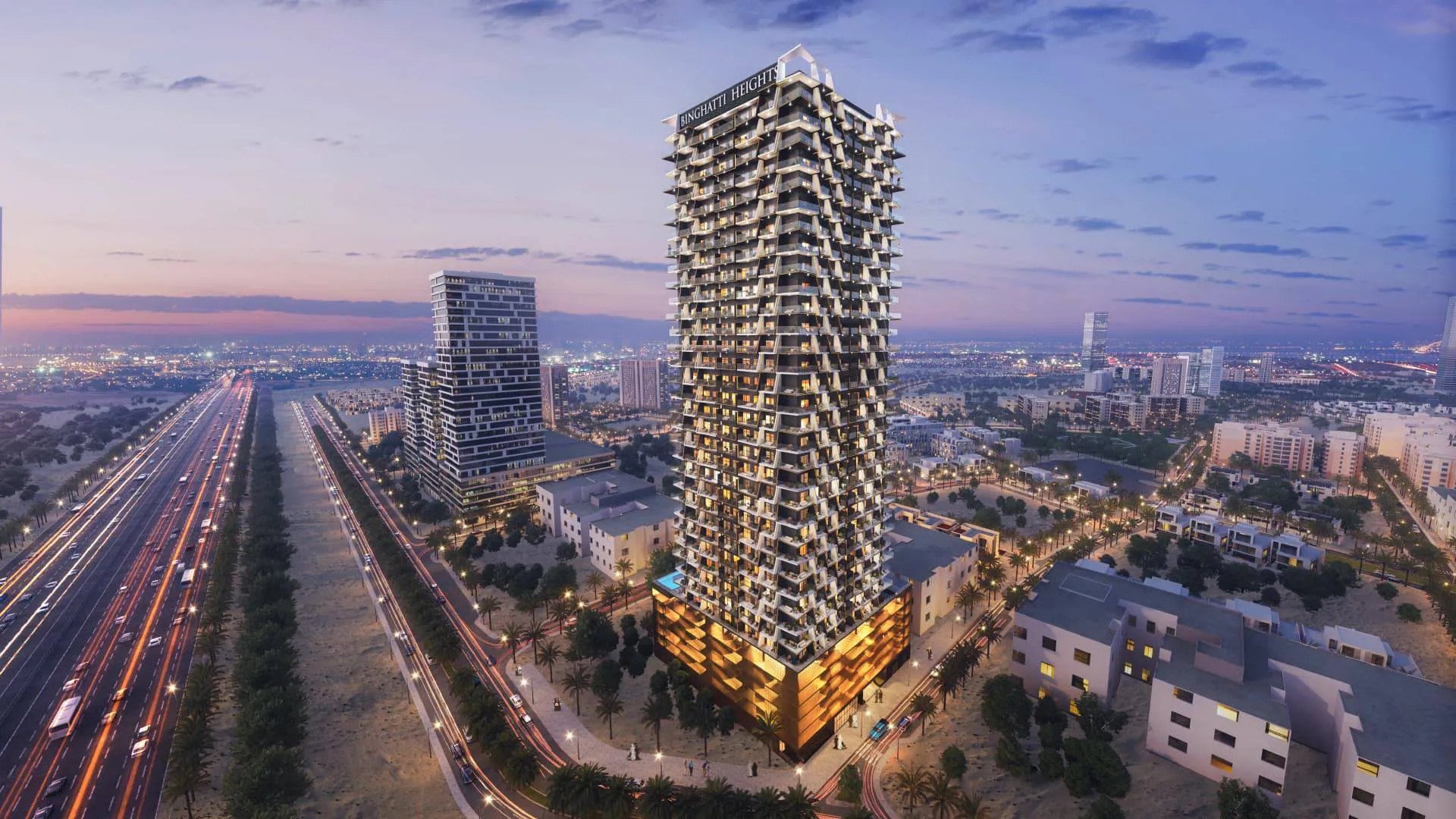
Binghatti is the most visually recognisable developer in Dubai, and that is a commercial strategy rather than an accident of taste. In a market where thousands of apartments share the same glass facade, the same lobby and the same balcony, Binghatti's interlocking balconies and sculptural elevations do something specific: they make a unit identifiable in a photograph. Whether that is worth paying for is the real question this guide answers.
The developer's headline projects are branded residences carrying names like Bugatti, Mercedes-Benz and Jacob & Co. Beneath them sits a much larger portfolio of conventional towers in central districts, and that is where most buyers actually transact. This guide covers what distinguishes Binghatti, where it builds, how the payment plans work, the investment case, and where the strategy is weaker than the marketing suggests. To compare it against everything else releasing now, browse off plan Dubai projects across the city.
What makes Binghatti distinctive
Three things matter to a buyer, and they interact.
Bold, recognisable architecture
The signature interlocking balconies and sculptural facades give the buildings a visual identity that carries across the range. This is not an aesthetic footnote. It changes how the asset behaves in a marketplace, for reasons covered further down.
Hyper-branded residences
Partnerships with global luxury marques create ultra-premium, design-led product aimed at buyers who want a trophy asset. These towers sit at the top of the range and generate the headlines and the brand equity that lift recognition of the whole portfolio.
Fast delivery in central locations
Binghatti has built a reputation for rapid construction and a strong presence in central districts, blending prime positioning with accessible pricing. Delivery speed is worth more to an off-plan buyer than almost any brochure feature, because every month of delay is a month of rent you do not collect while your capital is committed. A shorter build shortens the window in which the market can move against you before you own something that generates income.
Binghatti's branded towers, and what a brand is actually selling
The branded residences are collaborations with luxury marques, targeting buyers who want a design-forward trophy. Alongside them, Binghatti delivers a wide portfolio of more accessible towers across central Dubai, giving investors options across budgets. The branded towers create the headlines; the broader portfolio provides the everyday investment opportunities.
What you get and what you pay for
A branded residence charges a premium over an equivalent unbranded unit in the same district. Part of that premium buys real things: better fit-out specification, more considered interiors, tighter management standards. Part of it buys a name on the door. The first part is durable. The second part is fashion, and fashion has a resale profile that construction quality does not.
The mechanism to watch is that a branded premium is easiest to earn on the first sale, when the launch, the marketing and the novelty all work in the developer's favour. On resale you are asking a second buyer to pay for a brand association that is no longer new. Sometimes they will. Sometimes the premium compresses toward the district average. Neither outcome is guaranteed, and any page telling you branded residences always outperform is selling you something. The useful test is to separate the two components before you pay: ask what the specification would be worth in an unbranded tower on the same street, and treat the difference as the price of the name.
Where Binghatti builds
Binghatti concentrates in central, high-demand districts, which is the most underrated thing about the developer. The design gets the attention; the location choices do the work.
Business Bay
A walkable, central district with corporate tenants and short-let demand, adjacent to Downtown without Downtown's pricing. Our Business Bay off-plan guide covers the district's demand drivers, and live stock sits on the Business Bay area page.
Jumeirah Village Circle
Value-community economics with high rental yields, which is the sweet spot for cash-flow investors. The trade-off in JVC is supply: it is one of the most actively built districts in the city, which is exactly why differentiation matters there more than anywhere. Read our JVC off-plan guide for the full picture.
This focus on proven, tenant-dense locations means Binghatti units generally sit where rental demand already exists rather than where it is forecast, which reduces void risk. That is a materially different risk profile from a suburban launch that depends on a district maturing around it.
Payment plans on Binghatti projects
Binghatti typically offers investor-friendly payment plans, often structured to keep the upfront barrier low during construction. The plan is not a discount, and it should not be read as one — a developer that spreads your payments is financing you, and financing is priced into the headline. What the plan changes is your cash profile, which is a different variable and often the binding one.
How to compare two plans honestly
Match the structure to your cash flow rather than to the percentage on the brochure. A front-loaded plan on a lower headline price and a back-loaded plan on a higher one can produce very different outcomes depending on what else your money could be doing during the build. Our payment plans hub sets out the structures side by side, including post-handover plans where instalments continue after you have keys and rental income.
The costs that are not in the plan
Your upfront cash is a fraction of the headline price, but it is not just the first instalment. DLD transfer fees, registration and the Oqood entry all land early, and they are real money that no payment plan spreads for you. Budget them as day-one cash rather than as a rounding error on the purchase price.
Why design-led property rents and resells well
There is a practical reason the architecture matters beyond aesthetics: differentiation sells. In a rental market with thousands of near-identical apartments, a unit in a striking, recognisable building stands out the moment a prospective tenant scrolls a listing page or arrives for a viewing. That visibility can mean faster lettings, fewer void periods, and the ability to command a modest premium over generic stock nearby.
Void period is where this pays. A unit empty for two months has surrendered roughly a sixth of its annual income — more damage than any service-charge negotiation will ever recover. Anything that shortens the time from listing to signed tenancy is worth more than it looks on a spreadsheet. The same applies on resale: a memorable building is easier to market and leaves a stronger impression on a buyer comparing six similar options.
The limit of the argument is equally important. Design will not carry a poorly located or overpriced unit. It is a multiplier on demand fundamentals, not a substitute for them. This is exactly why Binghatti's concentration in Business Bay and JVC matters so much: it pairs the standout architecture with districts where the demand already exists. Get both working together and you have a genuine edge. Get only the design, and you own a photogenic vacancy.
How Binghatti compares to other developers
Where Emaar offers master-community scale and Sobha competes on build quality, Binghatti's edge is bold design and fast delivery in central locations, frequently at accessible prices. It is a more design-forward, momentum-driven play than the established blue-chip names.
Momentum is the word to sit with. A developer known for speed and volume is a developer with a lot of units completing, which is good for delivery risk and less good for the supply picture in the districts it favours. In JVC in particular, you should assume you will be letting and eventually selling against a large volume of new stock. Differentiation is the answer to that problem, which is coherent — but it means the design premium is doing real work rather than decorating a safe position.
The fundamentals still decide the outcome: strong location, sensible entry price, and a unit that will rent and resell. Design sits on top of those, not in place of them.
Who should buy Binghatti
- Design-focused investors who want a distinctive, immediately identifiable asset in a crowded listing market.
- Yield investors targeting high-demand value communities such as JVC, where differentiation offsets heavy supply.
- Short-let investors seeking standout central units in Business Bay, where a recognisable building genuinely converts bookings.
- Luxury buyers drawn to the ultra-premium branded residences, who understand they are paying for a name as well as a fit-out.
It suits you less if you are a conservative capital-preservation buyer who wants the safest possible blue-chip name, or if you are buying a large family villa — that is not what this developer builds. Higher-value units can also support a Golden Visa at the AED 2M+ threshold, and Dubai's absence of tax on rental income sharpens the net return relative to most other markets. Foreigners can buy Binghatti freehold without residency. Live releases sit on the Binghatti developer page.
Frequently Asked Questions
Is Binghatti a good developer? It has a strong record of fast delivery in central, tenant-dense districts, which is the risk that matters most to an off-plan buyer. Its edge is design and speed rather than master-community scale or the highest build specification, so match it to what you actually want from the asset.
What are Binghatti's branded residences? Towers developed in collaboration with global luxury marques including Bugatti, Mercedes-Benz and Jacob & Co. They sit at the top of the range and combine a higher fit-out specification with a brand association — understand that you are paying for both, and that only one of them is durable.
Where does Binghatti build in Dubai? Predominantly in central, high-demand districts, with a strong concentration in Business Bay and Jumeirah Village Circle. Both are locations where rental demand already exists rather than being forecast, which reduces void risk relative to emerging suburbs.
Does the distinctive design actually improve returns? It helps in a specific, measurable way: a recognisable building gets noticed in a listing feed, which shortens time-to-let and reduces void periods. It does not rescue a bad location or an inflated price. Treat it as a multiplier on fundamentals, not a replacement for them.
Can foreigners buy Binghatti property without UAE residency? Yes. Binghatti builds in freehold areas, so non-residents can buy, own and register in their own name without holding a residency visa.
Can I sell a Binghatti unit before handover? Usually yes, subject to the developer's minimum-payment threshold and an NOC. Most developers require a set share of the price to be paid before approving an assignment, so check the threshold in your SPA before building an exit strategy around a pre-handover resale.