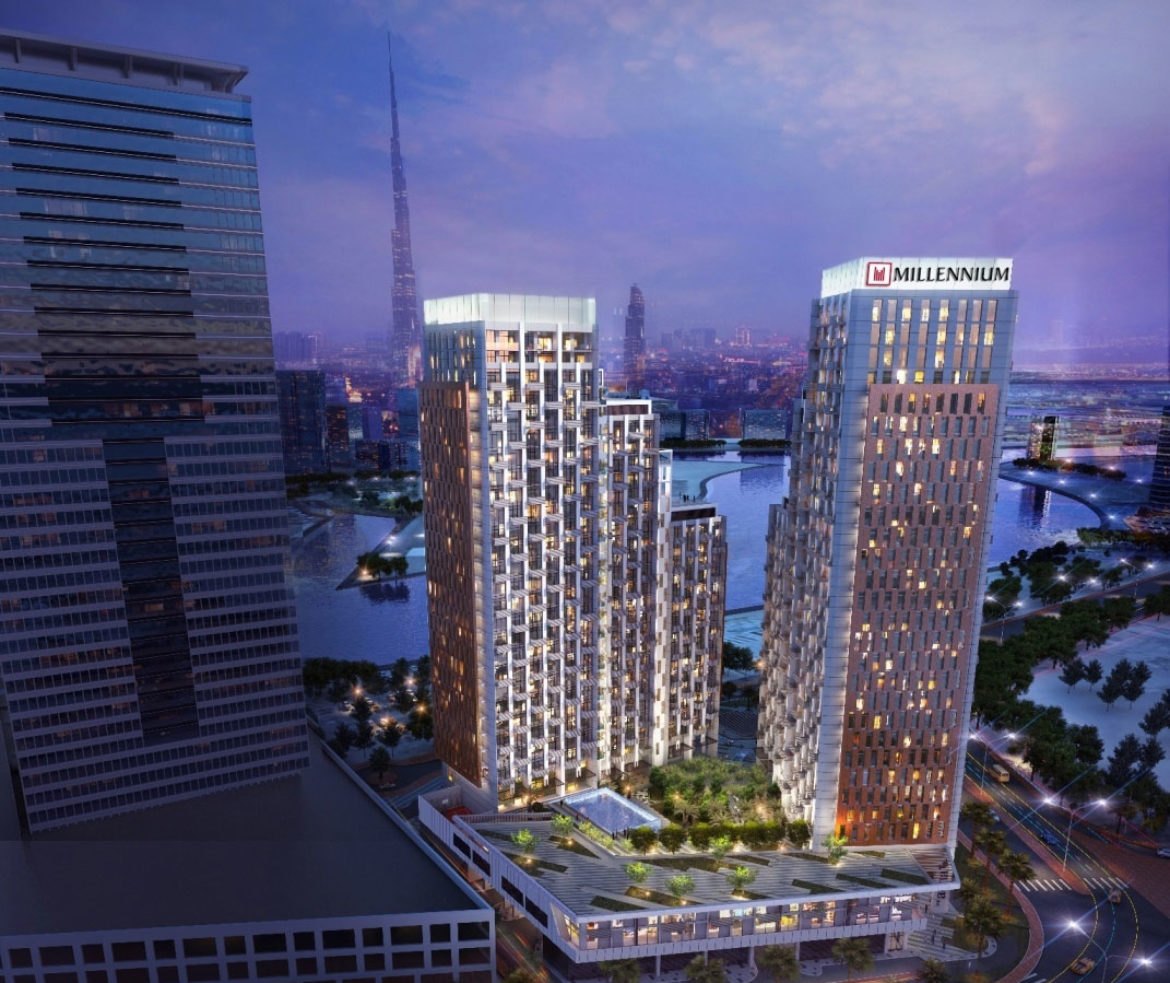
Business Bay is the closest thing Dubai has to a central business district you can also live in. It sits immediately south of Downtown, wrapped around the Dubai Water Canal, on Sheikh Zayed Road, with its own metro station. Off-plan property in Business Bay is a bet on that centrality holding its value as the city expands outward, and on the district's unusual ability to serve two different tenant markets at once.
This guide covers what the district actually is, why the dual demand matters more than the headline yield, what the amenity-heavy towers do to your net return, and who Business Bay genuinely suits. It also covers who it does not suit, because the district has a real weakness and it is worth naming. To see current stock while you read, browse off plan Dubai projects filtered by community.
What and where Business Bay is
Business Bay is a high-density, mixed-use district built along an extension of the Dubai Water Canal, master-planned as a commercial heart for the city. That origin still shows in the built form: office towers stand next to residential high-rises, hotels and canal-side promenades, with a food-and-beverage layer that has thickened considerably as the residential population filled in.
It is a designated freehold zone, so international buyers can own outright and purchase remotely. The defining feature is position. Business Bay puts Downtown, DIFC and the beach within a short drive, and unlike a pure office park it has matured into a round-the-clock neighbourhood. That last part is what makes it work as a residential investment rather than merely a commercial address.
Why centrality is a durable asset
Dubai keeps building outward. New communities offer more space for less money, and they will keep doing so. What they cannot manufacture is a fifteen-minute commute to DIFC. Land in Business Bay is finite and largely allocated. As the city's population grows and the average commute lengthens, the value of being central rises even if nothing in the district itself changes. That is the structural argument for the area, and it is a stronger argument than any single tower's brochure.
Why investors choose Business Bay
The district offers something rarer than pure yield or pure prestige. It offers both, balanced, and neither maximised.
- Corporate tenant demand. Proximity to DIFC, Downtown offices and Sheikh Zayed Road produces a steady flow of professional, well-paid renters who sign twelve-month leases and pay on time.
- Short-let upside. Canal views and a central position make Business Bay one of the strongest holiday-let markets outside the beachfront.
- Capital-growth character. Central districts with finite developable land have historically held value better through soft patches than fringe communities with open supply pipelines.
- Tax-free income. No income tax on rent, no annual property tax, no capital gains tax. The one-off 4% DLD fee at purchase is the main transaction cost.
The dual demand is the actual thesis
Most Dubai communities serve one market. JVC serves long-let residential. The beachfront serves tourists and trophy buyers. Business Bay serves corporate long-lets and short-stay visitors simultaneously, and this is worth more than it first appears.
The reason is optionality. If the long-let market softens, you can pivot the unit to short-let. If short-let regulation or seasonality bites, you drop back to a corporate tenant. You are not locked into one demand curve. In a market that moves in cycles, having two exits from a strategy rather than one is a genuine form of downside protection, and it is why the district holds up in periods that hurt single-demand communities.
Typical unit mix and who buys here
Business Bay is dominated by apartments, from compact studios aimed at single professionals through to spacious two-bedrooms, with a meaningful supply of branded and serviced residences. There is almost no villa or townhouse stock. This is a vertical, urban market, and if you want a garden you are in the wrong postcode.
The typical buyer
An investor who wants a central, name-recognisable address with flexibility between long and short lets. End-users are usually young executives who want to live minutes from work and are willing to trade space for time. Branded residences here also attract trophy-minded buyers who are buying a name as much as a floor area.
Studios and one-beds for short-let
Smaller units with canal or skyline views are the workhorses of the short-let strategy. They are cheap to furnish, easy to fill and strong on nightly rate relative to their size. Larger units lean toward stable corporate long-lets, where a family or a senior employee on a company package wants two bedrooms and will stay for years.
Rental demand and yield character
Business Bay yields typically sit in the middle of Dubai's 6% to 8% band on a long-let basis. It is not a yield-maximising district and you should not buy it expecting to beat JVC on percentage. If a pure yield number is the only thing you care about, you should be looking at the value communities, and our best areas to buy off-plan guide positions the trade-offs across the city.
What Business Bay offers instead is the quality of that yield. A corporate tenant in a central district is a more reliable income stream than a marginal tenant in a fringe one, and the void periods are shorter because the demand is not seasonal. Yield percentage measures the size of the return. It does not measure its reliability, and the difference between the two shows up in a downturn.
The short-let reality
A well-located, well-managed short-let unit can outperform a long-let comfortably in peak season. It can also underperform badly. Short-let is an operating business, not a passive investment. It carries an operator fee, more frequent maintenance, furnishing capital, licensing requirements and real vacancy risk in the shoulder months. The units that win are the ones with a genuine view and active management. The ones that lose are the ones bought on a spreadsheet that assumed full occupancy at peak rates for twelve months.
Service charges and what they do to your net
This is where Business Bay demands the most attention. Towers here often carry rich amenity packages: pools, gyms, concierge, canal-facing facilities. Those amenities cost money to run, and the cost lands on the owner as a service charge levied per square foot.
Because rental income is not taxed in the UAE, the service charge is the principal deduction between your gross and your net. That makes it the single most important number after the price, and it varies by tower rather than by district. Two units in Business Bay with the same rent and the same price can deliver materially different net yields purely because one sits in a heavier building.
The amenities are not wasted money. They are precisely what lets these units command higher rents and stronger nightly rates, and a stripped-back tower with a low charge will also achieve a lower rent. The question is not whether the charge is high but whether the rent it supports more than covers it. Our service charges guide shows how to read a building's schedule before you buy so you can compare like with like across towers rather than trusting a district-level average.
Buying off plan in Business Bay: process and protection
Buying here follows Dubai's standard off-plan path. You reserve, sign the sales purchase agreement and pay a deposit plus the one-off 4% DLD fee. Your instalments then go into a RERA-regulated escrow account, from which the developer can only draw against verified construction progress certified on site. Your interest in the specific unit is recorded on the interim register via Oqood until handover, when it converts to a title deed.
That framework is what makes off plan in a fast-developing district reasonable rather than speculative. It is worth being clear about its limits, though. Escrow protects your money and Oqood protects your claim to the unit. Neither protects you against a delayed handover, and neither says anything about whether you paid the right price. Those risks remain yours, and in a district with as many towers under construction as Business Bay, delay is a normal outcome rather than an exceptional one. Budget for it.
Developers active in the district
Major developers including DAMAC and Binghatti have a strong presence here, competing on design and pricing within the same postcodes. Because the district's towers vary widely in finish quality and amenity load while sitting minutes apart, the developer you choose has more effect on your outcome in Business Bay than in a master community where one developer sets the standard across the whole plan.
Connectivity and lifestyle
Few districts are as connected. Business Bay metro station, direct Sheikh Zayed Road access and the canal promenade combine with a dense lifestyle layer: rooftop bars, canal-side restaurants, gyms and the Bay Avenue retail strip. Downtown's Dubai Mall and the Burj Khalifa are a walk or a short drive away. This is a genuine live-work-play environment, and it is what keeps occupancy high without heroic marketing.
The honest counterweight is that density has costs. Traffic on the internal roads at peak times is real, construction noise from adjacent plots is real, and the district is not quiet. A tenant who wants a lawn and a school run will not choose Business Bay, and you should not buy here expecting them to.
Who Business Bay suits, and who it does not
- Suits: investors wanting balance between yield, reliability and capital growth rather than a maximum on any one.
- Suits: short-let operators targeting business and leisure travellers near Downtown who will actually manage the asset.
- Suits: executive end-users who value a central, walkable base and will trade square footage for the commute.
- Does not suit: pure yield hunters, who will do better in value communities on percentage.
- Does not suit: family buyers wanting space, schools and quiet.
If you want more prestige and a slower yield, compare with off-plan property in Downtown Dubai, which sits a few minutes north and prices accordingly. If you want to see what is currently being released in the district and at what payment terms, the latest launches are the practical starting point.
Frequently Asked Questions
Is Business Bay good for short-term rentals? It is one of the strongest short-let markets outside the beachfront, because it draws both business and leisure travellers and sits minutes from Downtown. Short-let is an operating business, though, not passive income. It requires licensing, furnishing capital, active management and an honest vacancy assumption for the shoulder months.
What types of property are available off-plan in Business Bay? Almost entirely apartments, from studios to two-bedrooms, plus a meaningful supply of branded and serviced residences. There is essentially no villa or townhouse stock. It is a vertical district by design.
Can overseas investors buy off-plan in Business Bay? Yes. Business Bay is a designated freehold zone, so foreign nationals can own outright, and the purchase can be completed remotely. You will still need identity documentation and the funds must go to the project's escrow account.
Are service charges high in Business Bay? Often higher than in value communities, because the towers carry richer amenity packages that cost money to run. Because rental income is untaxed, that charge is your main deduction from gross to net, so check the specific building's schedule rather than a district average before you buy.
What yield should I expect in Business Bay? Typically the middle of Dubai's 6% to 8% gross band on a long-let. Value communities beat it on percentage. Business Bay's argument is the reliability of the income and the dual demand, not the size of the number.
Is Business Bay a better buy than Downtown? They serve different goals. Downtown carries more prestige and a higher entry price with a correspondingly lower yield. Business Bay gives you most of the location for less money and a better income profile. Which is better depends entirely on whether you are optimising for return or for the address.