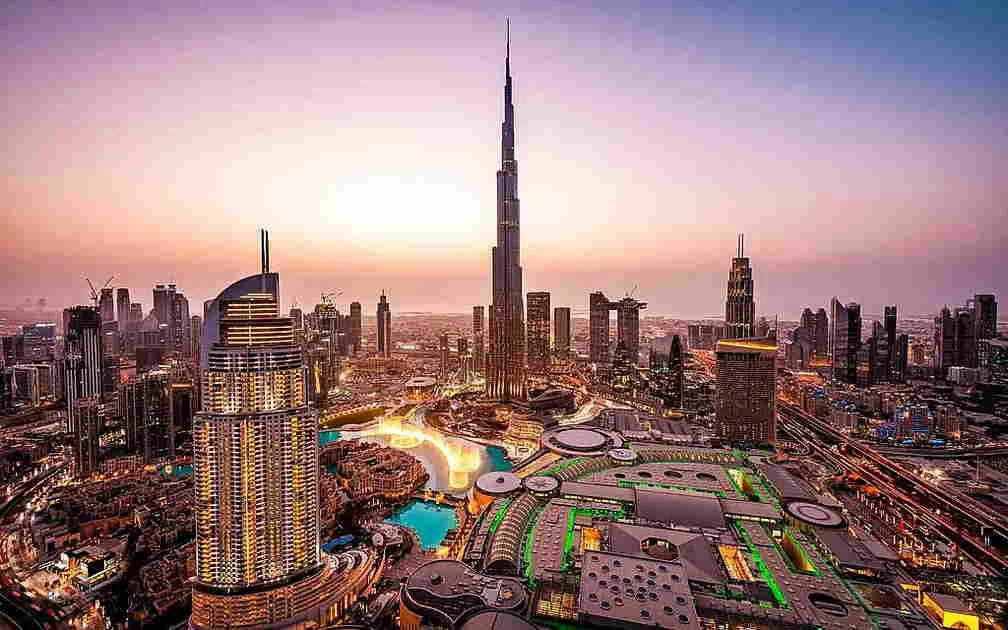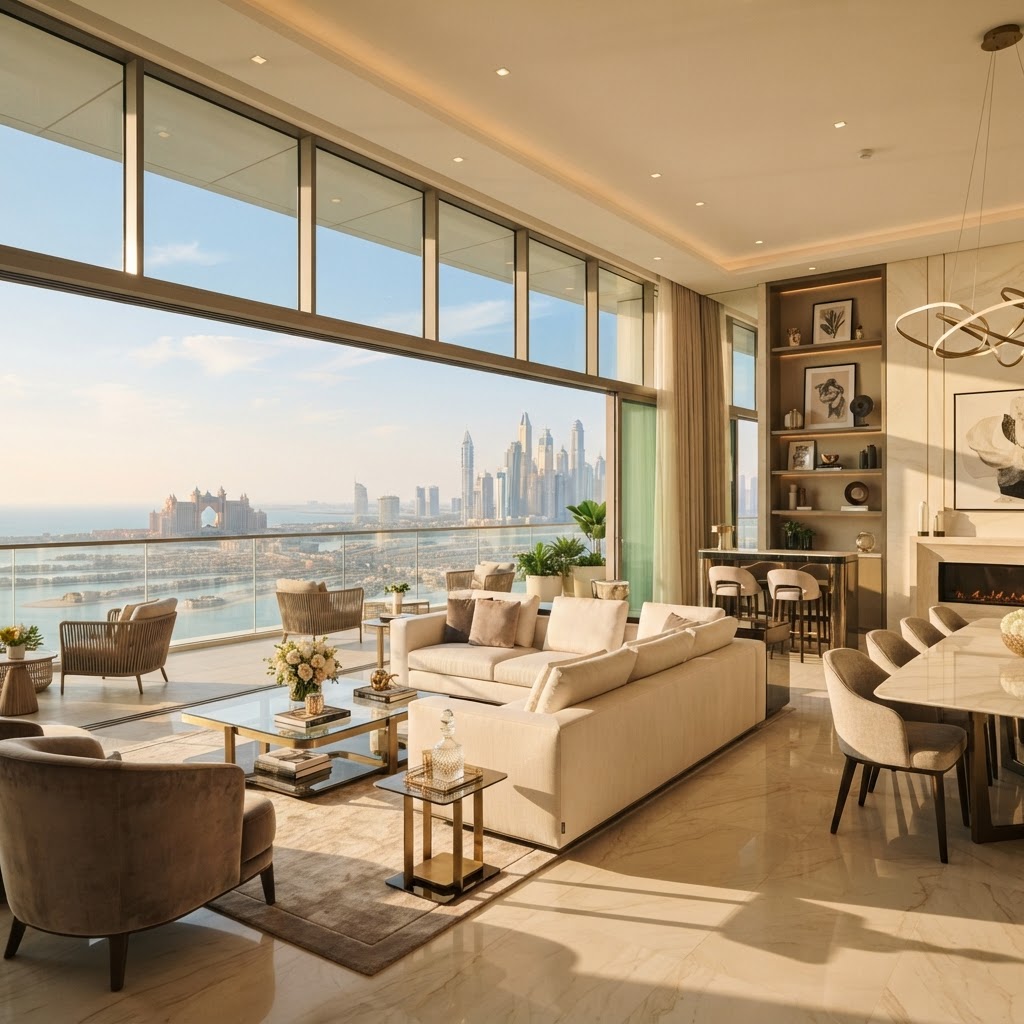
Dubai recorded 296 home sales above $10 million in the first half of 2026, the highest number the city has ever registered in a six-month period, according to Knight Frank. The combined value of those deals reached $5.1 billion, up 14% year on year. Volume rose 16% above the first half of 2025 and 49% above the first half of 2024.
The number is interesting less for its size than for its timing. It landed while the broader Dubai market was moderating from the pace of 2025. Two segments of the same city moved in opposite directions in the same six months, and understanding why is more useful than the headline. This piece takes the reported figures apart, explains the mechanisms behind them, and is honest about how little of the story transfers to a buyer shopping at a normal price point. If you are working further down the ladder, you can browse off plan Dubai projects by community and payment plan while you read.
What the numbers actually say
Four figures carry the whole report, and each of them measures something slightly different.
296 deals, $5.1 billion, and the year-on-year arithmetic
Volume rose 16% while value rose 14%. Those two numbers moving almost together tells you something specific: the average ticket size barely changed. This was not a half in which a handful of enormous deals dragged the total upward. It was a half in which more people bought at roughly the same kind of price. That distinction matters, because a value record built on two or three outliers is fragile, while a value record built on transaction count reflects a broader pool of buyers and is harder to reverse.
The 49% jump against the first half of 2024 is the more revealing comparison. Two years is long enough to strip out a single strong quarter and short enough that the same market cycle is still running. A segment that is half again as busy as it was two years ago is not experiencing a spike. It is operating at a different level.
The quarterly split is not a slowdown signal
There were 165 deals above $10 million in the first quarter and 131 in the second. The obvious reading is that momentum faded. The more careful reading is that at this size, quarterly counts are lumpy by nature. Trophy transactions do not arrive on a schedule. A single delayed signing, a single branded release that closes in April rather than March, moves the quarter by a percentage point that would be invisible in a market of thousands of sales. With samples this small, the half-year figure is the meaningful unit and the quarterly split is noise until it repeats.
The trophy tier is thickening, not thinning
26 deals above $25 million
Buyers closed a record 26 transactions above $25 million during the half. This is the figure that tells you the shape of the market rather than its size. In most cities, as you climb the price ladder the number of transactions collapses toward zero very quickly, because the pool of people who can write the cheque runs out. Dubai's $25m+ tier setting its own record at the same time as the $10m+ tier means the pyramid is getting thicker near the top, not just wider at the base of the luxury band.
Practically, that changes price discovery. When only two or three homes a year trade above a threshold, there is no market, only negotiations. When 26 trade in six months, comparable evidence exists, valuers have something to work with, and the next seller has an anchor. A tier with real comparables behaves more like a market and less like an auction.
The Aman Residences benchmark
The most expensive transaction of the half was a six-bedroom apartment at Aman Residences, developed by H&H, in Jumeirah Second. It sold for $114.9 million, equivalent to AED 422 million, one of the largest apartment deals the city has recorded.
The detail worth noticing is that it was an apartment. Historically, the very top of a residential market is villa territory, because land is what scarcity ultimately means. A nine-figure apartment sale says the branded-residence category has established that a floor in the right building, with the right operator attached, is treated as a comparable store of value to a plot. That is a structural change in what the market is willing to price, and it is the single reason so much ultra-prime demand now flows through new construction rather than resale.
Where the money went
Three communities dominated the $10m+ league table, and the ranking is more informative than the totals.
Dubai Hills Estate and Palm Jumeirah
Dubai Hills Estate led with 51 sales above $10 million, narrowly ahead of Palm Jumeirah with 50. Those two being level is the interesting part, because they sell entirely different things. The Palm sells water, an address the whole world recognises, and finite frontage. Dubai Hills sells space, greenery, schools and a golf course on the mainland. That both clear fifty deals at this price tells you the ultra-prime buyer is not one type of person. Roughly half of that money is buying a lifestyle for a family; roughly half is buying an asset with a recognisable name. Our dedicated guide on off-plan property on Palm Jumeirah goes further into how the island's supply constraint works.
Palm Jebel Ali: 40 deals in a community still under construction
Palm Jebel Ali followed with 40 sales above $10 million. This is the number that should make you sit up. Forty buyers each committed more than $10 million to a district that is still largely a construction site, on the strength of a masterplan, a developer track record and a drawing. Nothing else in the data set demonstrates the confidence of this buyer pool so cleanly.
It is also where the risk sits. Buying an unbuilt trophy home means underwriting delivery, and delivery on a project of that scale depends on infrastructure, contractors and materials markets that no buyer controls. The buyers doing this are, almost by definition, people for whom a delayed handover is an inconvenience rather than a financial event. That is not true of most people reading this, and it is the reason the behaviour of this tier should not be copied at a smaller scale without adjusting for it.
Why the top end decoupled from the wider market
Wealth migration is a flow, not a season
High-net-worth individuals continue to relocate to Dubai for its tax treatment, safety and lifestyle, and many anchor that move with a property purchase. This is the mechanism that makes the top end behave independently. A buyer relocating a household and a business is not making a yield calculation against local interest rates. They are making a life decision in which the home is the cost of entry. Demand of that kind does not soften when the mainstream market cools, because it was never responding to the same inputs.
The Golden Visa programme reinforces the pattern by making long-term residency a straightforward outcome of a qualifying purchase rather than a separate hurdle. At this price level the visa is not the motivation, but it removes friction from the decision. Our Golden Visa through property guide covers how the property route works in practice.
Branded residences give supply the shape the buyer wants
Supply is meeting that appetite mainly through branded residences, where hospitality and fashion names attach their standards to new towers and villa communities. The mechanism is worth stating plainly: a brand is a substitute for local knowledge. A buyer arriving from abroad cannot easily assess a Dubai contractor's finishing quality or a building's future management. An operator with a global reputation supplies an inspectable, portable proxy for both. That is what the premium buys, and it is why these schemes sell before they exist.
Scarcity at the top is real in a way it is not lower down
Dubai's mainstream market has an answer to rising prices: build more. The land exists, the approvals exist, and new supply arrives. The top end does not work that way. There is a fixed amount of Palm frontage, a fixed number of floors with an unobstructed skyline view, and a limited number of sites a global operator will attach its name to. When demand grows against inelastic supply, price moves. That is the whole of the divergence in one sentence, and it is why the mainstream cooling and the trophy tier setting records are not a contradiction.
Why so much of this runs through off plan
Most of the ultra-luxury activity flows through off-plan projects rather than resale, and there are two reasons for it.
The first is availability. The specific product this buyer wants — a branded, full-floor, current-specification home — mostly does not exist on the resale market, because it has only been built recently and the people who own it are not selling. If you want it, you buy it before it is finished. That is not a preference for off plan; it is the only route to the asset.
The second is the payment structure. Off-plan purchases are paid in instalments tied to construction milestones, with buyer funds held in a project escrow account and released against certified progress. For a buyer at this level, the instalment schedule is a minor convenience, but the escrow mechanism is not: it is the reason committing eight figures to an unbuilt building is a defensible decision rather than a leap of faith. If you are weighing the two routes for yourself, our comparison of off-plan versus ready property sets out the trade-off without the sales gloss.
What this means if you are not buying at $10 million
The read-across is weaker than it looks
The temptation is to read a record at the top as a signal for the whole market. Resist it. The $10m+ tier and the AED 1.5m apartment tier share a city and almost nothing else. They have different buyers, different motivations, different sensitivity to mortgage rates and different supply dynamics. The trophy tier does not lead the mainstream; it runs on a separate track. A record half at the summit tells you nothing reliable about what a one-bedroom in a value community will rent for next year.
What does transfer: the location signal
One thing does carry across, and it is the ranking. Very wealthy, well-advised buyers concentrated their money in three communities. That is expensive, informed judgement about where Dubai's long-term quality of address sits, and it is free to read. It does not mean you should buy in those communities — the entry prices are what they are — but it does tell you which parts of the map the market treats as permanent rather than cyclical. You can see what is releasing across the city on our new launches page and compare communities on the full off-plan project listings.
Reading a record honestly
Two cautions belong on this page.
First, a record half is a record half. It is not a forecast. Whether the pace holds through the second half depends on the pipeline of branded launches and on the continued pace of wealth migration into the emirate, and neither is guaranteed. The figures above describe what happened, not what will.
Second, concentration cuts both ways. A tier where three communities and one product category account for most of the activity is a tier with correlated risk. If appetite for branded residences cools, or if a delivery problem hits confidence in one flagship district, the effect will not be spread thinly across the segment. It will land on exactly the assets that produced the record. Buyers at every price level should hold both facts at once: the strength is real, and it is narrow.
Frequently Asked Questions
How many Dubai homes sold above $10 million in H1 2026? There were 296 sales above $10 million in the first half of 2026, according to Knight Frank, the highest number recorded for any six-month period. Their combined value was $5.1 billion, up 14% year on year.
What was the most expensive Dubai home sale of the half? A six-bedroom apartment at Aman Residences in Jumeirah Second, developed by H&H, sold for $114.9 million, equivalent to AED 422 million. It ranks among the largest apartment transactions the city has recorded.
Which communities recorded the most $10m+ sales? Dubai Hills Estate led with 51 sales above $10 million, Palm Jumeirah followed with 50, and Palm Jebel Ali recorded 40 despite still being largely under construction.
Why is the ultra-luxury market rising while the wider Dubai market cools? The two tiers respond to different inputs. Ultra-prime demand comes largely from relocating wealth that is not making a yield calculation, and it meets genuinely inelastic supply — finite waterfront, finite prime floors, a limited number of sites global operators will brand. The mainstream market can answer higher prices with more construction; the top end cannot.
Does a record at the top mean I should buy off plan now at a lower price point? No. The trophy tier does not lead the mainstream market, and the two segments have different buyers, supply pipelines and rate sensitivity. Use the data for what it reliably shows — which communities informed capital treats as permanent — and underwrite your own purchase on its own payment plan, handover date and net yield.
Why do ultra-luxury buyers purchase off plan rather than ready? Mainly because the product does not exist ready. Branded, current-specification homes have only been built recently and existing owners are not selling, so the only route to the asset is buying before completion. Escrow protection on staged payments is what makes that commitment defensible.