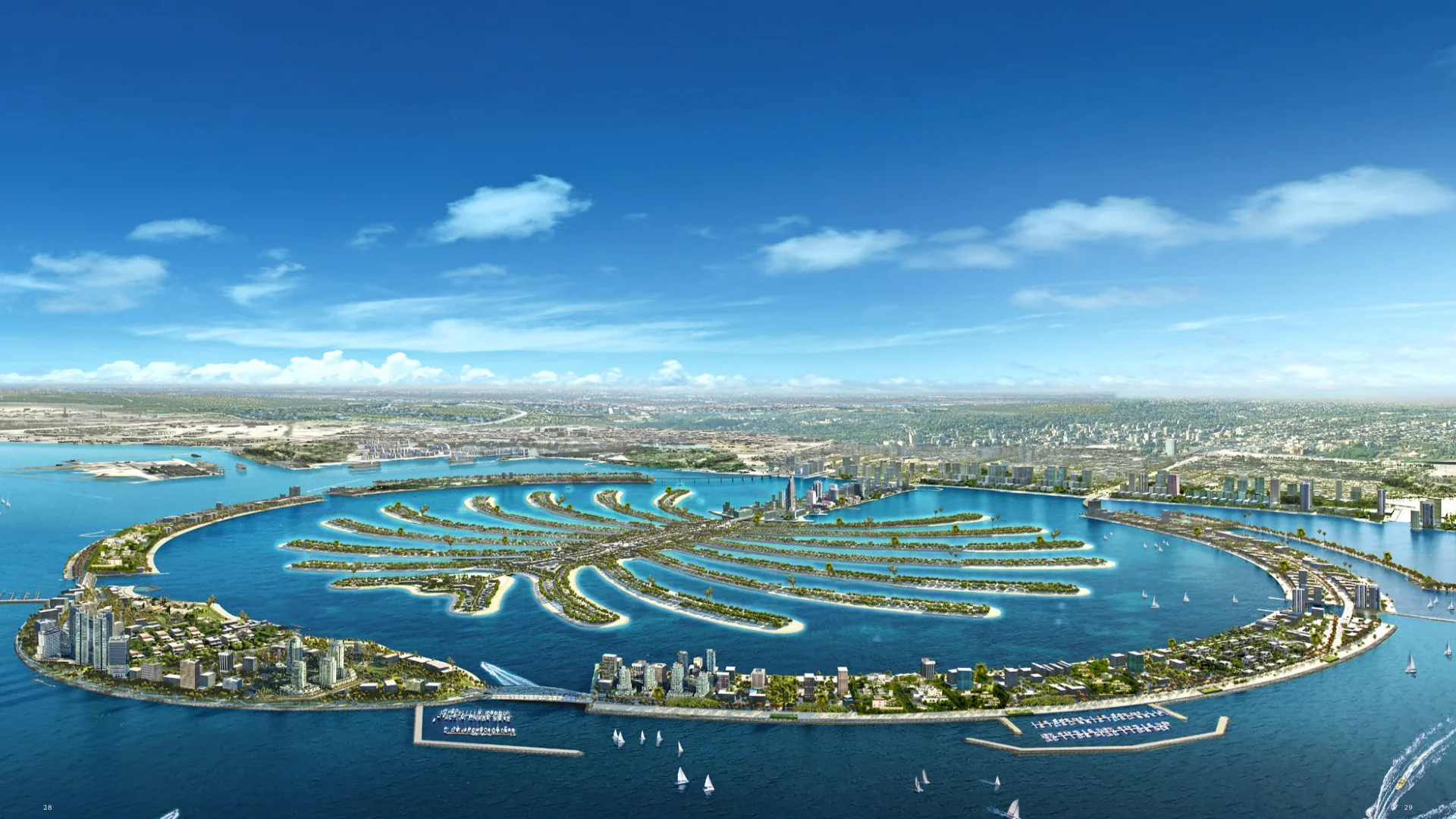
Dubai's second, larger palm-shaped island is no longer just a render. In 2026 Nakheel's Palm Jebel Ali moved decisively from planning into delivery, with fresh construction contracts signed and the developer reporting that the first ultra-luxury villa handovers are scheduled to begin later this year. It is one of the clearest signals yet that Dubai's most ambitious waterfront masterplan, roughly twice the size of the original Palm Jumeirah, is being built out.
That sentence has been written about this island before and turned out to be premature. What is different now is that the evidence is contractual and physical rather than promotional. This piece sets out what is actually happening on site, what the sales picture looks like, and — the part that matters if you are considering a purchase — how to read progress reporting on a masterplan of this scale without drawing the wrong conclusion from it. If you want to compare it against the rest of the market, you can browse off plan Dubai projects across communities and developers alongside this.
What is actually happening on site
The contracts
According to Gulf News, Nakheel awarded around AED 3.5 billion in additional villa contracts in April 2026, covering Fronds A to F. That sits on top of roughly AED 5 billion awarded earlier to contractors including Ginco, Shapoorji Pallonji Mideast and UNEC. More than 720 Beach and Coral Collection villas are under construction across Fronds K to P.
Why awarded contracts are the strongest signal available
Of everything a developer can announce, a signed construction contract is the hardest to fake and the most informative. A masterplan is a drawing. A sales launch is a marketing decision. A contract award is a binding financial commitment to a third-party contractor with its own balance sheet, its own schedule and its own lawyers.
The identity of those contractors carries information too. Ginco, Shapoorji Pallonji Mideast and UNEC are established regional builders with real delivery histories. Large tier-one contractors mobilise for jobs they expect to be paid for. When a developer has committed roughly AED 8.5 billion in villa contracts across two tranches, the project has moved past the stage where it can quietly be shelved.
Reading the progress percentage properly
Nakheel's own progress reporting has cited overall project progress in the high-20% range, with infrastructure works — roads, utilities, power and telecom — considerably further advanced.
The instinct is to read high-20% as "barely started" and worry. That misreads how island masterplans sequence. Land reclamation and infrastructure come first and consume an enormous share of the cost and time while producing nothing a buyer can photograph. Villas go up comparatively fast once serviced plots exist. A project at high-20% overall with infrastructure well ahead of that is a project where the slow, expensive, invisible work is largely done and the fast, visible work is beginning. That is a healthier profile than the number suggests in isolation.
The inverse is the trap. A tower at 60% with no district infrastructure around it is in worse shape than an island at high-20% with roads and utilities in the ground.
Access
Access is being built out too. A new six-kilometre road connecting Sheikh Zayed Road directly to the island is under contract, with a substantial tranche of major infrastructure works targeted for completion by the end of 2026. On an island development, the access road is not a convenience — it is the thing that determines whether an address is a location or an expedition. It deserves as much of your attention as the villa specification.
Sales momentum
What has sold
Demand has been strong from launch. Multiple frond collections have released commercially, and reporting indicates roughly 700 homes sold with show villas and sales facilities operational. First villa handovers are being guided for late 2026, with fuller frond completions expected across 2027 and 2028 depending on collection.
What a show villa actually tells you
An operational show villa is worth more than it appears in a sales update. It means the design is frozen, the specification has been priced and procured, and someone has physically built the product at least once. Projects that never get past renders have not resolved those questions. A buyer walking a completed show villa is buying with far better information than a buyer reading a brochure, and that information asymmetry is one of the real, under-appreciated risks of very early off-plan.
The handover cadence
Note the phrase "depending on collection". Handovers on a masterplan this size are not one event. Fronds K to P are under construction while Fronds A to F have only recently been contracted, which means two buyers on the same island can be years apart on delivery. Before you compare prices between fronds, establish which delivery cohort each one sits in. A discount on a later frond may simply be the price of waiting longer, correctly reflected.
The off-plan investor angle
Palm Jebel Ali sits at the ultra-prime end of Dubai's off-plan spectrum, and that shapes the investment case in specific ways.
Scarcity of beachfront
Signature waterfront villa plots are inherently limited. Early frond buyers are positioning ahead of the island's full build-out and its planned 80-plus hotels and resorts. Scarcity is the most durable argument in real estate because it is the one thing that cannot be manufactured in response to demand. Dubai can build more towers in Dubai South. It cannot build more original coastline, and reclaiming new coastline is a decade-scale project, as this island itself demonstrates.
The honest counterweight: scarcity supports price over long horizons and does nothing for liquidity over short ones. The buyer pool for an ultra-prime beachfront villa is small by definition. When you sell, you are not selling into the deep, two-sided market that a one-bedroom apartment enjoys. You are waiting for a specific type of buyer. That is fine if you can wait and expensive if you cannot.
Long horizon, staged capital
With handovers stretching to 2027 and 2028, this is a patient-capital play. Construction-linked payment plans spread the outlay but reward buyers who can hold through delivery. That structure is the mechanism that makes a large ticket accessible, and it is also where buyers get into trouble: the instalment schedule is an obligation, not an option. Committing to a plan you can only service if circumstances stay favourable turns a long-horizon asset into a forced sale at the worst possible moment. Size the commitment against income you are confident of, not against income you hope for. Our payment plans guide covers how the structures differ.
Growth corridor
The island anchors Dubai's south-western growth corridor toward Al Maktoum International Airport and Expo City. That is a genuine long-term infrastructure story, and it is also a long-term one. Corridor value accrues as the corridor fills in, which happens over years and does not follow a straight line. Buyers who understand they may hold a completed villa in a partially built-out island for a period, while the surrounding hospitality and retail arrive, do well. Buyers who assumed the island would be finished on the day their keys arrived do not. This is the single most common disappointment in Dubai masterplan buying, and it is entirely predictable.
Developer track record
Nakheel built the original Palm Jumeirah, which is the most relevant credential anyone could hold for this specific job — nobody else in the world has delivered a palm-shaped island and watched it mature into a functioning, high-value community over two decades. It is also true that Palm Jebel Ali's own history includes a long dormant period, which is precisely why the current contract awards matter as evidence rather than as marketing. Our Nakheel off-plan overview and the Nakheel developer page set out the wider portfolio.
Golden Visa territory
Villa price points here comfortably clear residency thresholds, which makes the visa question a non-issue rather than a feature to optimise for. Residency follows the purchase here rather than shaping it, so it should not be the reason you pick one frond over another.
What to do before you commit
Four things, in order of how much money they save you.
- Establish your delivery cohort. Ask which frond, which collection, and which contract tranche your specific villa sits in. That determines your handover year more than any general project statement does.
- Underwrite the hold, not the flip. Assume you hold through handover and into a partially complete surrounding community. If the numbers only work on an assignment before completion, you are relying on a resale market and a developer approval you do not control.
- Read the specification, not the render. Walk the show villa. Get the finishes schedule in writing and check it against what you were shown.
- Plan the handover itself. Ultra-prime villas have long snagging lists precisely because there is more to get wrong. Budget time and a professional inspection. Our snagging and handover guide covers the process.
Then compare it against the field rather than against the brochure. Browse waterfront stock on our off-plan projects page before deciding this is the right ultra-prime exposure for you.
Bottom line
After years of uncertainty, Palm Jebel Ali is being built. Contracts are signed with tier-one contractors, more than 720 villas are rising across Fronds K to P, infrastructure is ahead of headline project progress, and the first keys are expected to change hands in 2026. The delivery question is closer to settled than it has been at any point in the island's history.
The investment question is separate and remains open, as it should. This is a premium, long-horizon, low-liquidity bet on Dubai's most iconic new coastline, in a community that will still be filling in around your villa for years after you take the keys. For a buyer with patient capital and a realistic picture of what the first years look like, that is a coherent proposition. For anyone who needs an exit on a schedule, it is not.
Frequently Asked Questions
When are the first Palm Jebel Ali villa handovers? Nakheel is guiding the first ultra-luxury villa handovers to begin in late 2026, with fuller frond completions expected across 2027 and 2028 depending on collection. Your specific handover year depends on which frond and contract tranche your villa sits in, so confirm the cohort rather than relying on the earliest date quoted.
How much construction has actually been contracted? Nakheel awarded around AED 3.5 billion in additional villa contracts in April 2026 covering Fronds A to F, on top of roughly AED 5 billion awarded earlier to contractors including Ginco, Shapoorji Pallonji Mideast and UNEC. More than 720 Beach and Coral Collection villas are under construction across Fronds K to P.
Is high-20% project progress a concern? Not in isolation, and the composition matters more than the figure. Nakheel reports infrastructure works — roads, utilities, power and telecom — considerably further advanced than overall progress. On island masterplans the reclamation and servicing phase consumes most of the cost and time while producing nothing visible; villas rise comparatively quickly once serviced plots exist.
How big is Palm Jebel Ali compared with Palm Jumeirah? Roughly twice the size of the original Palm Jumeirah, with a planned 80-plus hotels and resorts across the island. The scale is why delivery is phased across fronds and collections over several years rather than completing as a single event.
What is the main risk for a Palm Jebel Ali buyer? Liquidity and community build-out timing. The buyer pool for ultra-prime beachfront villas is thin by definition, so exits are slow, and you should expect to hold a completed villa in a partially finished island while surrounding hospitality and retail arrive. Both are manageable with patient capital and damaging without it.
How is the island connected to the mainland? A new six-kilometre road connecting Sheikh Zayed Road directly to the island is under contract, with a substantial tranche of major infrastructure works targeted for completion by the end of 2026. On an island development the access road is a core value driver, not a detail.